
Interesting facts about plants: how they eat, breathe and talk
Plants make their own food, breathe day and night and even warn their neighbours when insects attack. Here are the most surprising facts about plants, with examples from Indian homes and gardens.
Rohit Tandon · 26 October 2026 · 4 min read
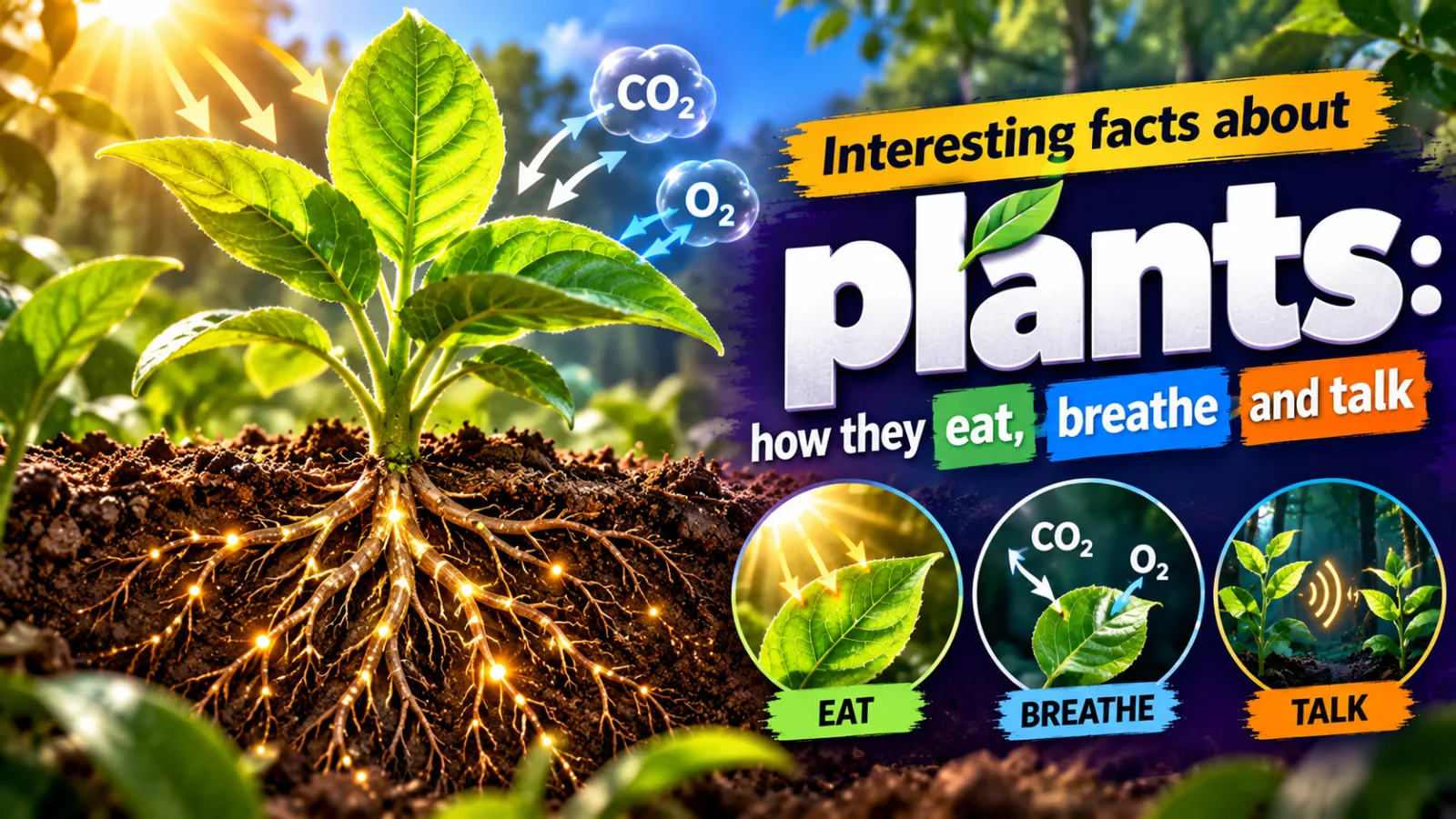
Want to know पेड़-पौधों के रोचक तथ्य, the most interesting facts about plants? In short: plants cook their own food from sunlight, they breathe all the time like we do, and when insects attack they release chemical signals that nearby plants can pick up. A plant may not move, but it is busy every second of the day.
How do plants make their own food?
Plants make food by photosynthesis. The green pigment in leaves, chlorophyll, traps sunlight, and the plant uses that energy to join carbon dioxide from the air with water from the roots. The result is glucose, a sugar the plant uses for energy and growth, and oxygen, which it releases into the air.
Chlorophyll absorbs red and blue light well but reflects green light, which is why most leaves look green to us. Think of the tulsi plant in an Indian courtyard: it grows faster on a sunny wall than in a dark corner, simply because it gets more light to cook with. You can read about other wonders of living things in our 15 interesting biology facts, from the cell to the blue whale.
Do plants breathe like us?
Yes. Plants respire day and night, taking in oxygen and releasing carbon dioxide to burn their sugar for energy. During the day, photosynthesis is much faster than respiration, so a green plant gives out more oxygen than it uses. At night, with no light, only respiration goes on.
Plants breathe through tiny pores called stomata, mostly on the underside of leaves. The same pores also let water vapour escape, a process called transpiration. On a hot May afternoon, the cool shade under a neem or peepal tree feels cooler partly because thousands of leaves are giving off water vapour, much like a matka cools water by letting it seep and evaporate.
Can plants really talk to each other?
Plants do not speak, but they do send chemical messages. When a caterpillar chews a leaf, many plants release airborne chemicals, and nearby plants that sense them start making defence substances before the insects reach them. Scientists have shown this in plants such as tomatoes and wild tobacco.
That fresh smell when someone mows a lawn or cuts grass in a park is, in fact, a group of such chemicals released by damaged leaves. Under the ground, roots are also linked by threads of fungi that help move water, nutrients and signals between plants. Clever communication is not only an animal skill, as you can also see in our page on why crows are among the smartest birds.
Which plants hold world records?
Some plants break every record in the book. The table below lists a few of the best-known record holders and where they grow.
| Record | Plant | Where |
|---|---|---|
| Oldest known single tree | Bristlecone pine "Methuselah", about 4,800 years old | White Mountains, California, USA |
| Tallest known tree | Coast redwood "Hyperion", about 116 m | Redwood National Park, California, USA |
| Largest single flower | Rafflesia arnoldii, about 1 m across | Rainforests of Sumatra and Borneo |
| Fastest growing plant | Some bamboos, up to about 90 cm in a day | Asia, including north-east India |
| A tree that looks like a forest | The Great Banyan, with thousands of prop roots | Acharya Jagadish Chandra Bose Indian Botanic Garden, Howrah |
The Great Banyan in Howrah lost its main trunk long ago, yet it survives through its prop roots, which grew down from the branches and became new trunks. Walking under it feels like walking through a small forest, though it is one tree. India has many such natural wonders, and our list of 10 interesting facts about India covers more of them.
Did you know? Tiny ocean plants and algae called phytoplankton produce roughly half of the oxygen on Earth, so every second breath you take comes from the sea.
Why do some plants move or eat insects?
Touch a chhui-mui (touch-me-not, Mimosa pudica) and its leaflets fold within seconds. Water quickly moves out of special cells at the base of the leaves, so they lose their stiffness and droop. Children in Indian villages often play this game on the way to school, without knowing they are watching a water-pressure trick.
Some plants grow in soil so poor in nitrogen that they catch insects to make up for it. The pitcher plant found in the hills of Meghalaya traps insects in a slippery jug filled with digestive juice. The Indian scientist Jagadish Chandra Bose built an instrument called the crescograph that recorded very small movements of plants, and showed that plants respond to light, heat and touch.
Key points
- Plants make glucose and oxygen from sunlight, carbon dioxide and water by photosynthesis.
- Plants respire day and night through tiny pores called stomata.
- Damaged plants release chemicals that warn nearby plants of insect attack.
- The oldest known single tree is about 4,800 years old and the tallest is about 116 m tall.
- Jagadish Chandra Bose's crescograph showed that plants respond to the world around them.
Frequently asked questions
Do plants give oxygen at night?
Most plants do not make oxygen at night because photosynthesis needs light. At night they only respire, taking in a little oxygen and giving out carbon dioxide.
Why are leaves green?
Leaves contain chlorophyll, which absorbs red and blue light for photosynthesis. It reflects green light, so that is the colour our eyes see.
Can plants feel touch?
Plants have no nerves, but many respond to touch, like the chhui-mui folding its leaves or a creeper curling round a stick. For more such science stories, browse our science articles.
Sources: NOAA: How much oxygen comes from the ocean? and Encyclopaedia Britannica: Photosynthesis.
Sources
Found this useful? Share it.