
The history of money: from barter to digital payments
Money began as barter, moved to cowries and coins, then to paper notes and now to phones. Here is the history of money, with India's part in it.
Rohit Tandon · 30 October 2026 · 4 min read
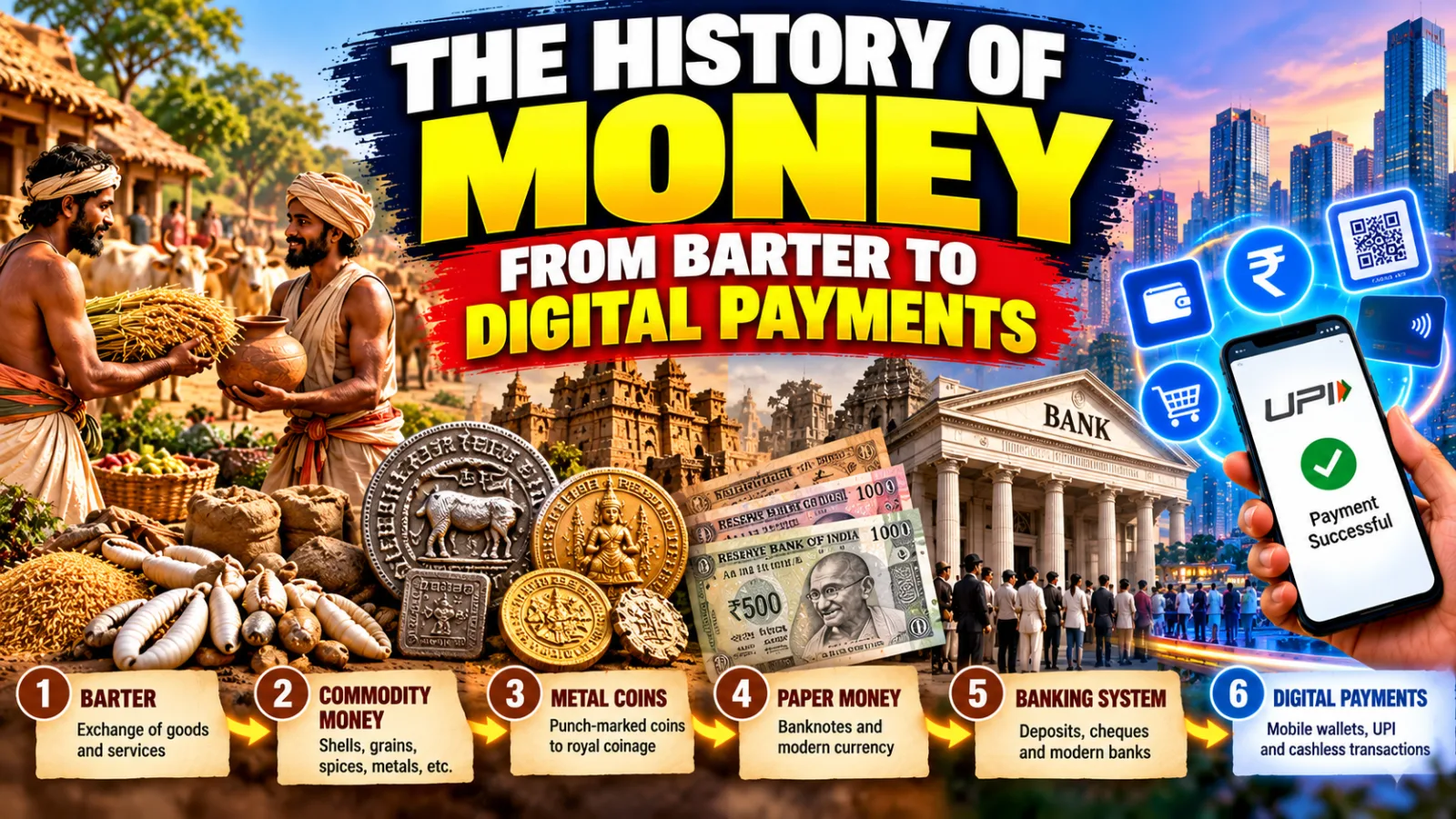
The history of money (पैसे का इतिहास) runs from barter, where people swapped goods, to cowrie shells and metal coins, then paper notes and finally digital payments on a phone. At each step, people found a way to trade that was easier to carry, count and trust. India played a part at almost every stage, from some of the world's oldest coins to UPI.
How did people trade before money?
The earliest trade was barter: one thing was exchanged directly for another, such as grain for cloth or a goat for clay pots. Imagine a family today trying to pay the vegetable seller with a bag of rice. It might work once, but only if the seller wants rice at that very moment.
Economists call this the "double coincidence of wants", and it was barter's biggest problem. Large goods also could not be split, since nobody can trade half a cow. Grain, fruit and milk spoil, so wealth could not be saved for long. People needed something that everyone would accept and that would last.
What were the first forms of money?
The answer was commodity money, meaning useful or rare objects that everyone valued. Cattle, grain, salt and metal pieces all served this purpose in different places. Small cowrie shells from the Indian Ocean were especially popular, because they were light, hard to fake and easy to count.
Cowries were used as small change in parts of India for many centuries. In the Lydian kingdom, in present-day Turkey, stamped coins appeared around 600 BCE. In India, silver punch-marked coins, often called karshapana, were in use from around the 6th century BCE. Our article on amazing facts about ancient India shows how busy trade already was in that period.
| Stage | Example | When |
|---|---|---|
| Barter | Grain swapped for cloth or pots | Before money existed |
| Commodity money | Cattle, salt, cowrie shells | Thousands of years ago |
| Metal coins | Lydian coins; Indian punch-marked coins | About 600 BCE; from about the 6th century BCE |
| Paper money | Jiaozi notes in China | 11th century CE |
| Silver rupiya | Coin of Sher Shah Suri | 1540s |
| Digital payments | UPI in India | 2016 |
How did paper money begin?
Coins were heavy, so merchants in China began leaving coins with trusted dealers and carrying paper receipts instead. Under the Song dynasty in the 11th century, these receipts grew into Jiaozi, often called the world's first government-backed paper money. A note was useful only because people trusted that it could be exchanged for something real.
That trust is still the heart of money today. A ₹500 note costs only a few rupees to print, yet a shopkeeper accepts it because the Reserve Bank of India stands behind it. The RBI was set up on 1 April 1935 and issues India's banknotes, except the ₹1 note, which the Government of India issues.
How did the Indian rupee develop?
The word "rupee" comes from the Sanskrit "rupya", meaning shaped or stamped silver. In the 1540s Sher Shah Suri issued a silver coin called the rupiya, and the Mughals and later the British kept using the name. India moved to decimal coins on 1 April 1957, when one rupee was divided into 100 naya paise.
Many grandparents still remember coins of 1, 5 and 10 paise, which bought sweets or a cup of tea. On 15 July 2010 India adopted the rupee symbol ₹, designed by D. Udaya Kumar. Festivals keep the old link between money and luck alive, and you can read about it in our article on the meaning of Dhanteras, when many families buy gold, silver or new utensils.
Did you know? The rupee symbol ₹ combines the Devanagari letter "र" with the Roman capital "R", and the two lines at the top also stand for the national flag.
How did money become digital?
Card payments and net banking came first, but the biggest change in India came with the Unified Payments Interface (UPI). Built by the National Payments Corporation of India, UPI was launched in 2016. It lets anyone send money from one bank account to another in seconds using only a phone number or a QR code.
Today a tea seller at a railway station or a vendor at a weekly market often displays a QR code, and a train ticket can be paid for in the same way. In December 2022 the RBI also began a pilot of the digital rupee, or e₹, a digital form of the banknote itself. You can learn more in our article on Digital India, Aadhaar, UPI and DigiLocker, and find more surprising stories among our amazing facts.
Key points
- Barter failed because both sides had to want each other's goods at the same time.
- Cowries, cattle and salt served as early commodity money.
- India's punch-marked coins date from around the 6th century BCE.
- China's Jiaozi of the 11th century is counted among the first paper money.
- Sher Shah Suri's silver rupiya of the 1540s gave the rupee its name.
- UPI, launched in 2016, made phone payments common across India.
Frequently asked questions
What is the history of money in India today?
Today India uses coins, RBI banknotes and digital payments side by side. UPI has made phone payments common even in small shops, and the RBI is testing the digital rupee.
Who introduced the rupee?
Sher Shah Suri issued a silver coin called the rupiya in the 1540s. The name stayed through Mughal and British rule and is still used today.
Why does a banknote have value?
A note has value because people trust it and the central bank stands behind it. The paper itself is worth very little.
Sources: Reserve Bank of India and UPI product overview, National Payments Corporation of India. Both are official bodies of India's payment system.
Sources
Found this useful? Share it.