
The mystery of Stonehenge and its ancient stones
Stonehenge was raised in stages from about 3000 BCE, with stones dragged from 25 km, 225 km and even 700 km away. Here is what scientists know, and what is still a mystery.
Rohit Tandon · 31 October 2026 · 4 min read
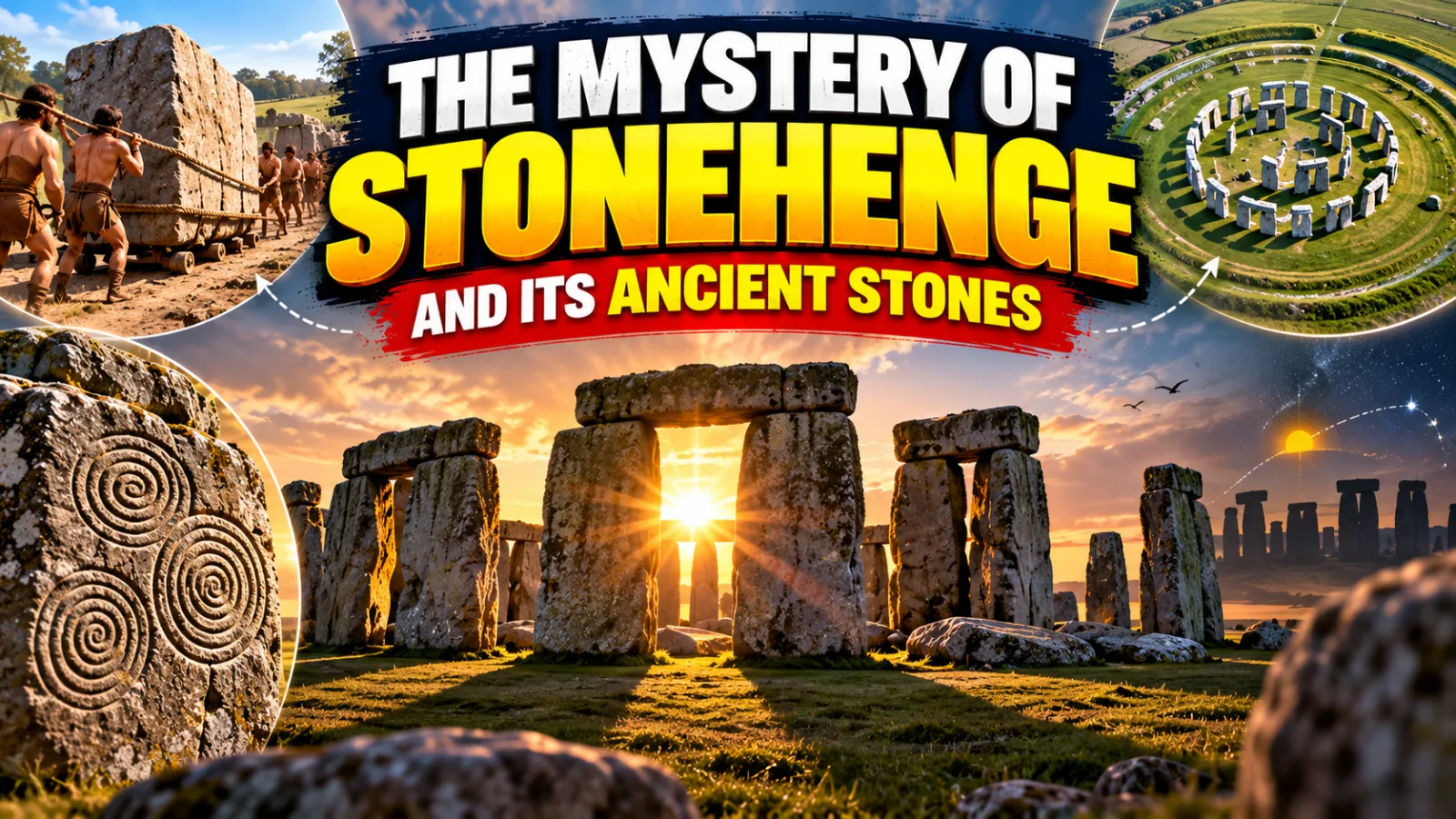
स्टोनहेंज का रहस्य — the mystery of Stonehenge — comes down to three questions: who raised these giant stones on Salisbury Plain in England, how they moved them without machines, and why. Scientists now know that farming people built it in stages from about 3000 BCE, and that its stones came from 25 km, 225 km and even about 700 km away. The "why" is still argued over.
What is Stonehenge, and where is it?
Stonehenge is a ring of standing stones in Wiltshire, in southern England. Its tallest pieces are the sarsens, huge blocks of hard sandstone, some of them weighing up to about 25 tonnes. Pairs of sarsens carry a flat stone across their tops, like a giant doorway, and smaller "bluestones" stand inside the ring.
In 1986 UNESCO named Stonehenge, together with the nearby stone circle at Avebury, a World Heritage Site. Today it is cared for by English Heritage. Like the Konark Sun Temple in Odisha, it is a stone monument built with the sun in mind, though it is more than 4,000 years older.
When and by whom was Stonehenge built?
Stonehenge was not built all at once. Work went on in several stages over roughly 1,500 years, by people who farmed, kept cattle and used stone and bone tools. They had no metal tools in the early stages, no wheels for heavy loads and no writing, so everything we know comes from digging and science.
| When | What happened |
|---|---|
| About 3000 BCE | A circular ditch and bank are dug; the site is also used for burials |
| About 2500 BCE | The big sarsens are raised and the top stones are locked on |
| The next centuries | The bluestones are moved and rearranged several times |
| 1986 | Stonehenge and Avebury become a UNESCO World Heritage Site |
| 2020 | A study traces most sarsens to West Woods, about 25 km to the north |
| 2024 | The Altar Stone is traced to north-east Scotland |
A popular story says the Druids built it, but the Druids lived some 2,000 years later. Another legend, written down in the 12th century, credits the wizard Merlin. Neither has any support from the evidence found in the ground.
Where did the stones come from?
Most sarsens came from West Woods, about 25 km away. The bluestones, a few tonnes each, came from the Preseli Hills in Wales, about 225 kilometres away. That is roughly the distance from Delhi to Agra, covered on foot with a stone on a wooden sledge.
The biggest surprise came in 2024. A study in the journal Nature showed that the Altar Stone, a flat block of about 6 tonnes lying at the centre, came from north-east Scotland, about 700 km away. A later study ruled out the Orkney islands, so the exact spot in Scotland is still being searched for.
Did you know? The Altar Stone at Stonehenge was carried about 700 km from north-east Scotland nearly 5,000 years ago, a longer trip than the one from Mumbai to Goa by road.
How were the giant stones moved and raised?
No one wrote down the method, but experiments show what could work. A stone placed on a wooden sledge can be pulled over greased timber rails by a large team with ropes. Anyone who has seen a heavy steel almirah slid across a floor on round wooden logs has seen the same idea at a smaller scale.
To stand a stone upright, the builders probably dug a pit with one sloping side, slid the stone in and hauled it up with ropes and levers. The top stones were fixed with joints copied from woodwork: a knob on the upright fits a hollow in the lintel, much like the joints a village carpenter cuts in a charpai frame.
Why was Stonehenge built?
The clearest clue is the sun. The main axis of Stonehenge lines up with sunrise on midsummer's day and sunset on midwinter's day. Each June, thousands gather there for the summer solstice, the same longest day on which India marks International Yoga Day on 21 June.
Cremated human remains found at the site show it was also a burial place. Some researchers think it marked the turning of the year for farmers, others see a place of ceremony that brought distant groups together. Without writing, as with many places in our amazing facts collection, the full answer may never be known.
Key points
- Stonehenge stands on Salisbury Plain in Wiltshire, England, and was built in stages from about 3000 BCE.
- The big sarsens, up to about 25 tonnes, were raised around 2500 BCE and came mostly from about 25 km away.
- The bluestones came from Wales, about 225 km away, and the Altar Stone from north-east Scotland, about 700 km away.
- Its axis lines up with the midsummer sunrise and the midwinter sunset.
- It became a UNESCO World Heritage Site, with Avebury, in 1986.
Frequently asked questions
How old is Stonehenge?
Building began about 3000 BCE, so the oldest part is about 5,000 years old. The big sarsens went up around 2500 BCE, before even the oldest buildings of ancient Indian universities like Nalanda.
Did aliens or the Druids build Stonehenge?
No. Farming people of the Stone Age built it, using sledges, ropes, timber and very large teams. The Druids came about 2,000 years later.
Why is Stonehenge still called a mystery?
We know when it was built and where its stones came from. Its builders left no writing, so the exact reason they built it is still debated.
Sources: English Heritage: Stonehenge history and UNESCO World Heritage Centre: Stonehenge, Avebury and Associated Sites.
Sources
Found this useful? Share it.