
Which is the largest lake in India? Wular, Chilika and Loktak
Wular is India's largest freshwater lake and Chilika its largest brackish-water lagoon. Here is how to answer the exam question correctly, with every record lake in one table.
Rohit Tandon · 7 October 2026 · 3 min read
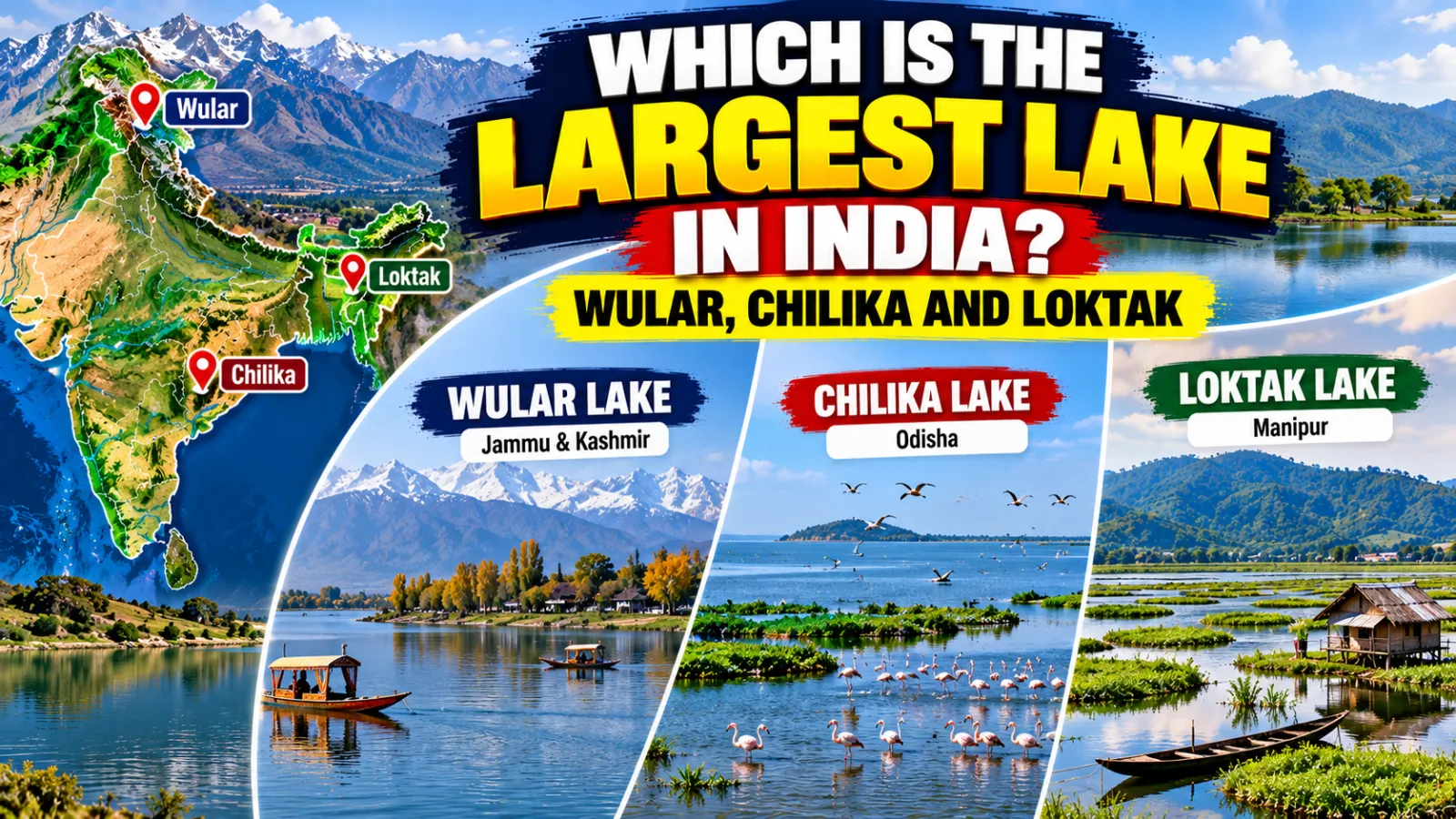
भारत की सबसे बड़ी झील — the largest lake in India — depends on the kind of water. Wular Lake in Jammu and Kashmir is the largest freshwater lake, while Chilika Lake in Odisha is the largest brackish-water lake, a coastal lagoon. If an exam asks only for "the largest lake", read the options: the expected answer is usually one of these two.
India has other record holders too. Sambhar is the largest inland salt lake, Vembanad the longest lake and Loktak the lake with floating islands. The sections below explain each one and the reason some lakes are sweet and others salty.
Which is India's largest freshwater lake?
Wular Lake lies in the Bandipora district of Jammu and Kashmir and is counted among the big freshwater lakes of Asia. The Jhelum river flows into it and out again, so the lake works like a huge natural tank on the river's path. Its size changes a great deal with the seasons, swelling after snowmelt and rain and shrinking in dry months.
This swelling is useful. When the Jhelum floods, Wular soaks up the extra water and protects towns in the Kashmir valley, much as a village pond fills during a heavy monsoon shower and saves nearby homes from water. Wular is also a Ramsar site, a wetland of international importance.
Which is India's largest saltwater lake?
Chilika Lake in Odisha is India's largest brackish-water lake. It is a lagoon, a shallow body of water cut off from the Bay of Bengal by a thin strip of sand, where sea water mixes with river water. According to the Chilika Development Authority, its water spread changes from about 900 sq km in summer to about 1,165 sq km in the monsoon.
Every winter lakhs of migratory birds arrive at Chilika, and the lake is home to the rare Irrawaddy dolphin. Thousands of fishing families depend on it for prawns, crabs and fish. In 1981 Chilika became one of India's first Ramsar sites.
Did you know? Loktak Lake in Manipur has floating islands of grass and soil called "phumdis". On them lies Keibul Lamjao, the world's only floating national park and home of the endangered sangai deer.
What are the other record lakes of India?
| Lake | State or region | What stands out |
|---|---|---|
| Wular | Jammu and Kashmir | Largest freshwater lake |
| Chilika | Odisha | Largest brackish-water lagoon |
| Sambhar | Rajasthan | Largest inland salt lake |
| Vembanad | Kerala | Longest lake; Nehru Trophy boat race |
| Loktak | Manipur | Floating phumdis and Keibul Lamjao park |
| Dal | Jammu and Kashmir | Shikaras and houseboats |
| Pangong Tso | Ladakh | Long high-altitude salt lake, much of it across the border |
Among man-made lakes, Govind Ballabh Pant Sagar, formed by the Rihand dam in Uttar Pradesh, is often counted among the largest. Such reservoirs store water for power, irrigation and drinking. For more records of this kind, see our page of facts about India's tallest, longest and biggest.
Why are some lakes fresh and others salty?
A lake stays fresh when water flows both in and out, as the Jhelum does through Wular. The moving water carries dissolved salts away before they can build up. A lagoon like Chilika is brackish because the sea pushes in through its mouth and mixes with rivers coming from the land.
Sambhar is salty for a different reason. It sits in a dry region on the eastern edge of the Thar Desert, and its water has no outlet, so the sun evaporates the water and leaves the salt behind. Sambhar has long been a source of common salt, the same white crystals that end up in a kitchen salt box. Rivers work the other way, as our page on the world's largest rivers shows: they keep moving to the sea.
Why do lakes matter, and what are Ramsar sites?
Lakes give drinking water, fish and tourism income. A shikara ride on Dal Lake and the snake-boat race on Vembanad each support many families. Lakes also absorb flood water and refill groundwater, so a city that fills its lakes with garbage and buildings often floods in the monsoon.
The Ramsar Convention, an international agreement on wetlands, was signed in 1971 in the Iranian city of Ramsar. India now has more than 100 Ramsar sites, including Chilika, Loktak, Wular and Sambhar. World Wetlands Day is marked every year on 2 February.
Key points
- Largest freshwater lake: Wular, in Bandipora, Jammu and Kashmir.
- Largest brackish-water lake: Chilika, Odisha, about 900 to 1,165 sq km by season.
- Largest inland salt lake: Sambhar, Rajasthan; longest lake: Vembanad, Kerala.
- Loktak in Manipur has the world's only floating national park, Keibul Lamjao.
- India has more than 100 Ramsar sites; Chilika joined the list in 1981.
Frequently asked questions
Which is the largest lake in India?
Wular is the largest freshwater lake and Chilika the largest brackish-water lake. In an exam, check whether the question says fresh water or salt water before choosing.
Which is the largest salt lake in India?
Sambhar in Rajasthan is the largest inland salt lake. Chilika is larger, but it is a coastal lagoon of mixed sea and river water, not an inland salt lake.
Which is the longest lake in India?
Vembanad in Kerala is the longest lake in India. It is famous for its backwaters and the Nehru Trophy boat race; more such topics are in our geography section.
Sources: Chilika Development Authority, Government of Odisha and Encyclopaedia Britannica: Wular Lake.
Sources
Found this useful? Share it.