
India’s largest prison: facts about Tihar and its reforms
Delhi's Tihar is India's largest prison: nine central jails on about 400 acres. Why it is overcrowded, how Kiran Bedi reformed it, and what prisoners learn there.
Rohit Tandon · 7 October 2026 · 3 min read
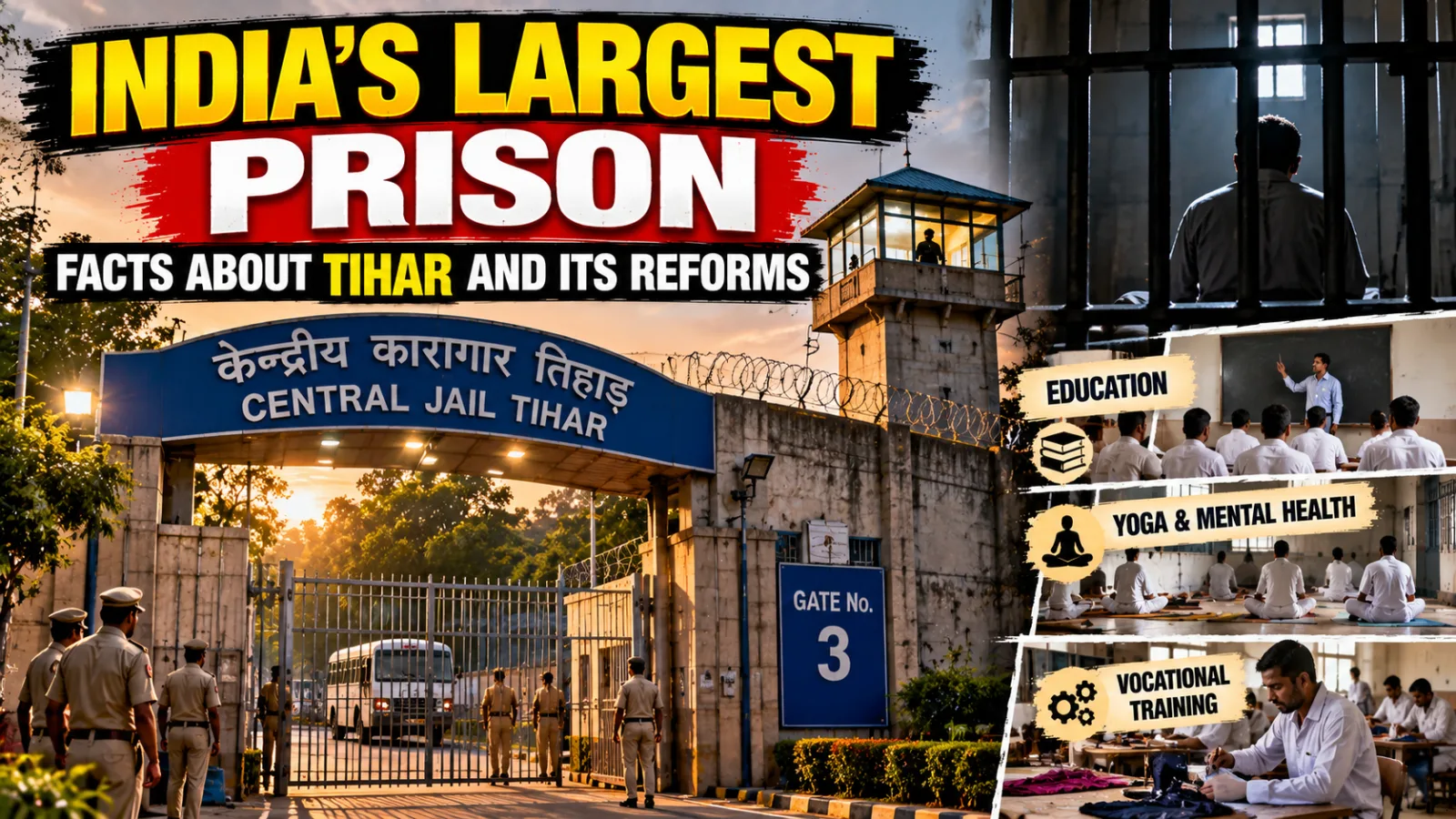
Which is the largest prison in India (भारत की सबसे बड़ी जेल)? It is Tihar Jail in West Delhi, a complex of nine central jails spread over about 400 acres and counted among the largest prison complexes in South Asia. Tihar is known not only for its size but also for its experiments in turning prisoners back into working citizens.
Where is Tihar Jail and how big is it?
Tihar stands in West Delhi, near the old Tihar village from which it takes its name, and it was set up in 1958. It is run by the Prisons Department of the Delhi government. Instead of one huge building, it is a campus of nine separate central jails, each with its own wards, kitchen and workshops.
As Delhi grew, more space was needed, so a central jail was built at Rohini and a complex of six jails at Mandoli. With Tihar, Delhi now has 16 central jails under one department. A jail campus like this works almost like a small town, with its own hospital, schools and factories.
| Fact | Tihar at a glance |
|---|---|
| Location | West Delhi, near Tihar village |
| Set up in | 1958 |
| Run by | Prisons Department, Delhi government |
| Area | About 400 acres |
| Jails in the complex | 9 central jails (plus 1 at Rohini and 6 at Mandoli) |
| Brand of prison-made goods | TJ's |
Why is Tihar always overcrowded?
Tihar's nine jails were built for about 5,000 prisoners, but they usually hold more than twice that number. Picture a Mumbai local train at rush hour, where a coach meant for a few hundred people carries far more and every seat and handle is shared. Overcrowding strains food, water, health care and the guards' attention in the same way.
A big reason is the number of undertrial prisoners, people whose cases are still going on and whom no court has found guilty. The National Crime Records Bureau's yearly "Prison Statistics India" report shows that about three out of four prisoners in India are undertrials. In its 2025–26 budget the Delhi government set aside ₹10 crore for a survey to shift the prison out of the crowded city.
How did Kiran Bedi change Tihar?
In May 1993 the IPS officer Kiran Bedi became Inspector General of Prisons in Delhi, which put Tihar in her charge. She brought in classes, yoga, complaint boxes and a panchayat system in which prisoners helped run daily life in the wards, much as a village panchayat settles local matters. For this work she received the Ramon Magsaysay Award in 1994.
In April 1994 a ten-day Vipassana meditation course was held inside Tihar for more than 1,000 prisoners, led by the teacher Satya Narayan Goenka. It is described as the largest Vipassana course of modern times, inside or outside a prison. The documentary "Doing Time, Doing Vipassana" later took this story around the world, and yoga is among the traditions in our piece on interesting facts about Indian culture.
Did you know? Tihar's prisoners make bakery goods, furniture, clothes and handicrafts that are sold under the "TJ's" brand. The work teaches them a trade and lets them earn and save for life after release.
How does Tihar help prisoners start again?
Modern prisons aim not only to punish but to reform, so that a person can return to society and stay away from crime. Tihar has study centres where prisoners take school and open-university courses, and many have passed exams while serving their sentence. For a young prisoner, clearing an exam behind bars can mean as much as a board result does for a student at home.
Vocational training covers tailoring, carpentry, computers and baking. Think of the biscuits and namkeen families buy before Diwali: similar goods are baked in Tihar and sold under the TJ's label. De-addiction help, counselling, sports and music support the same goal of a fresh start.
The Supreme Court has said in many judgments that a person in prison keeps fundamental rights, such as the right to live with dignity under Article 21. Prisoners have a right to legal aid and to protection from inhuman treatment, and legal services authorities in every district give free legal help to those who cannot pay a lawyer.
Which other Indian prisons are famous in history?
The Cellular Jail, or "Kala Pani", in Port Blair on the Andaman Islands was built between 1896 and 1906, and the British locked up many freedom fighters there. Today it is a national memorial. Pune's Yerwada Jail held Mahatma Gandhi several times and is linked with the Poona Pact of 1932.
These prisons are witnesses to the freedom struggle, while Tihar tells the later story of reform. You can find more surprising stories among our amazing facts articles and in our list of 50 amazing facts in Hindi and English.
Key points
- Tihar Jail in West Delhi is India's largest prison complex, with nine central jails on about 400 acres.
- It was set up in 1958 and is run by the Prisons Department of the Delhi government.
- Built for about 5,000 prisoners, it usually holds more than twice that number, many of them undertrials.
- Kiran Bedi's reforms, including Vipassana courses, won her the Ramon Magsaysay Award in 1994.
- Goods made by prisoners are sold under the "TJ's" brand.
Frequently asked questions
Which is the largest jail in India?
Tihar Jail in Delhi is the largest prison complex in India. It has nine central jails on about 400 acres and is among the largest in South Asia.
When was Tihar Jail built?
Tihar was set up in 1958 in West Delhi. Later, Delhi added a central jail at Rohini and six jails at Mandoli.
What is TJ's?
TJ's is the brand under which goods made by Tihar's prisoners are sold, such as bakery items, furniture and clothes. The work gives prisoners skills and earnings for life after release.
Sources: Delhi Prisons, Government of NCT of Delhi and National Crime Records Bureau (NCRB).
Sources
Found this useful? Share it.