
Interesting facts about Hindi: its history, dialects and place in the world
Hindi is the mother tongue of about 52.8 crore Indians and one of the most spoken languages on Earth. Here are its most interesting facts, from its name to its dialects and its reach abroad.
Rohit Tandon · 23 October 2026 · 4 min read
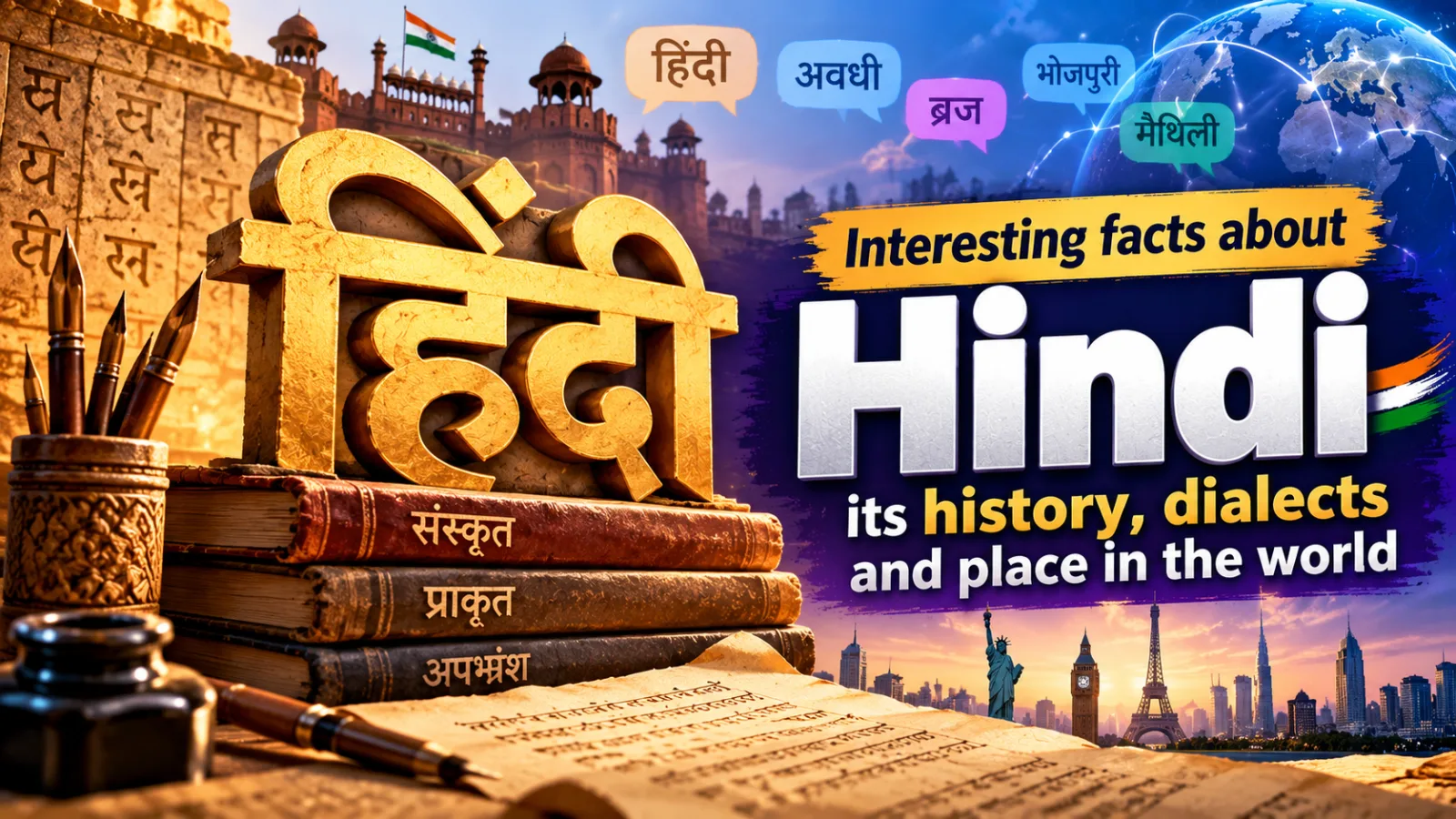
Looking for हिंदी भाषा के रोचक तथ्य, or interesting facts about the Hindi language? The short answer: Hindi is the mother tongue of about 52.8 crore Indians (2011 Census), it is written in the Devanagari script, and the Constitution names it the official language of the Union. Behind those plain facts sits a story of a thousand years, dozens of dialects and a language that travelled across oceans.
Where does the name "Hindi" come from?
In old Persian, the sound "s" was spoken as "h". So the land beyond the river Sindhu (Indus) became "Hind", and the language of its people became "Hindi", which simply means "the language of Hind". The same root gave us words like "Hindustan", and you can read more about it in our page on the old names of India such as Bharatavarsha and Hindustan.
Hindi did not appear overnight. It grew out of Sanskrit through Pali, the Prakrits and Apabhramsha over roughly a thousand years. The speech of the area around Delhi and Meerut, called Khari Boli, slowly became the base of the modern standard Hindi you read in newspapers and textbooks today.
How did modern Hindi grow?
For centuries, the great poetry of the Hindi belt was written in other dialects, not Khari Boli. Tulsidas wrote the Ramcharitmanas in Awadhi, and Surdas sang of Krishna in Braj Bhasha. Many grandparents still recite chaupais from the Ramcharitmanas during Navratri or at a village Ramlila, which shows how deep these older forms run.
Print changed everything. The first Hindi newspaper, Udant Martand, came out from Calcutta on 30 May 1826, and that date is now marked as Hindi Journalism Day. Our full story of India's first Hindi newspaper, Udant Martand, explains how a small weekly opened the door for Hindi prose. Later in the 19th century, Bharatendu Harishchandra wrote plays, essays and poems in Khari Boli, and he is often called the father of modern Hindi literature.
Which dialects belong to the Hindi family?
Hindi is less like one road and more like a river fed by many streams. The Census groups many mother tongues under the "Hindi" heading, and some of them have their own long literature. A person from Varanasi, one from Mathura and one from Rohtak may all say they speak Hindi, yet their everyday speech sounds quite different.
| Dialect | Main area | Known for |
|---|---|---|
| Khari Boli | Around Delhi and Meerut | Base of modern standard Hindi |
| Awadhi | Central Uttar Pradesh (Lucknow, Ayodhya) | Tulsidas's Ramcharitmanas |
| Braj Bhasha | Mathura, Vrindavan, Agra | Surdas's songs of Krishna |
| Bhojpuri | Eastern Uttar Pradesh and western Bihar | Folk songs, films and the Chhath geet |
| Bundeli | Bundelkhand (Jhansi, Sagar) | Folk ballads such as Alha |
| Haryanvi | Haryana | Ragini folk songs |
Bhojpuri deserves a special mention. During Chhath Puja, the four-day worship of the sun, the songs sung at the riverbank are mostly in Bhojpuri and Magahi. Families who now live in Mumbai or Delhi still play these songs at the ghat, which keeps the dialect alive in big cities.
What place does Hindi have in India's law?
On 14 September 1949, the Constituent Assembly agreed that Hindi in the Devanagari script would be the official language of the Union. That is why 14 September is celebrated as Hindi Diwas. Article 343 of the Constitution records this, and Article 351 asks the Union to help Hindi grow while drawing words from other Indian languages.
Official status does not mean a "national language". India's Constitution does not name any single national language, and English continues to be used for official work alongside Hindi. Hindi is one of the 22 languages listed in the Eighth Schedule, next to Tamil, Bengali, Marathi and others, a mix you can explore in our page on interesting facts about Indian culture, languages and festivals.
Did you know? Several everyday English words came from Hindi, among them "loot", "thug" and "shampoo". The last one comes from the Hindi word "champo", meaning to press or massage the head.
Where in the world is Hindi spoken?
In the 19th century, many Indian workers were taken to far-off colonies such as Fiji, Mauritius, Suriname, Trinidad and Guyana. They carried Bhojpuri and Awadhi with them, and those forms grew into local varieties. Fiji Hindi is today one of the official languages of Fiji, and Mauritius hosts the World Hindi Secretariat.
The first World Hindi Conference was held in Nagpur on 10 January 1975. In memory of it, 10 January is observed as World Hindi Day (Vishwa Hindi Diwas) since 2006. Today, Bollywood films, cricket commentary on TV and Hindi news on YouTube carry the language to viewers in the Gulf, the UK, the USA and Canada, where it is heard at Indian shops, temples and family weddings.
Key points
- About 52.8 crore Indians gave Hindi as their mother tongue in the 2011 Census, about 43.6% of the population.
- The name "Hindi" comes from the Persian "Hind", the land beyond the Sindhu river.
- Modern standard Hindi is based on Khari Boli; Awadhi and Braj carry its classic poetry.
- Hindi in Devanagari is the official language of the Union under Article 343; India has no single national language.
- Hindi Diwas falls on 14 September and World Hindi Day on 10 January.
Frequently asked questions
Is Hindi the national language of India?
No. The Constitution names Hindi in the Devanagari script as the official language of the Union, but it does not declare any national language. English is also used for official purposes.
Why is Hindi Diwas celebrated on 14 September?
On 14 September 1949, the Constituent Assembly accepted Hindi as the official language of the Union. Hindi Diwas marks that decision every year.
Which was the first Hindi newspaper?
Udant Martand, a weekly started in Calcutta on 30 May 1826, was the first Hindi newspaper. That is why 30 May is observed as Hindi Journalism Day. You can find more such stories in our रोचक तथ्य इन हिंदी collection.
Sources: Department of Official Language, Government of India and Encyclopaedia Britannica: Hindi language. Census figures are from the Census of India 2011 language tables.
Sources
Found this useful? Share it.