
Old names of India: Bharatavarsha, Jambudvipa, Aryavarta, Hindustan and India
The Constitution says "India, that is Bharat". Here is where Bharatavarsha, Jambudvipa, Aryavarta, Hindustan and India come from, and how one river gave the country most of its names.
Rohit Tandon · 8 October 2026 · 3 min read
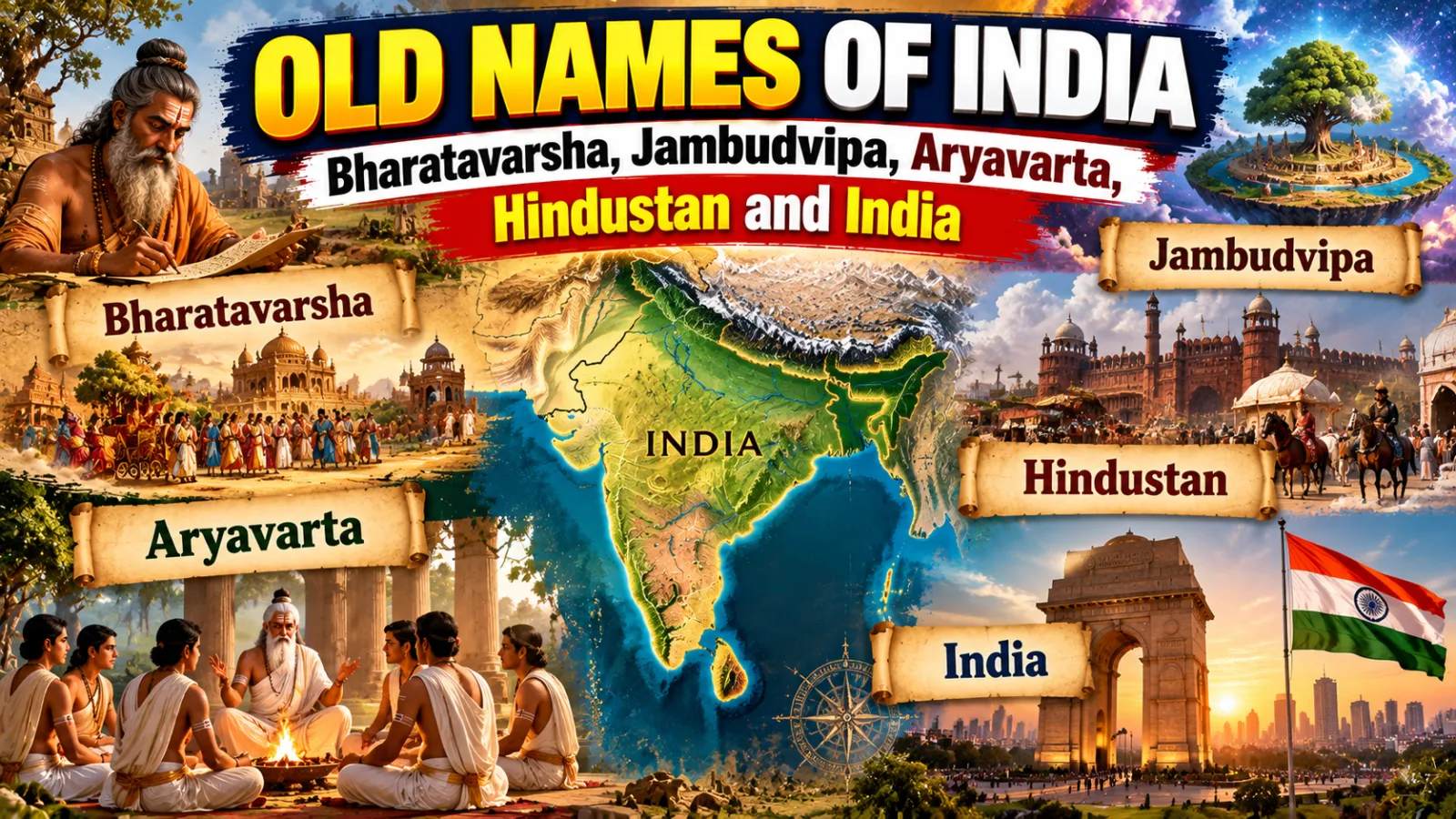
भारत के पुराने नाम — the old names of India — are Bharat or Bharatavarsha, Jambudvipa, Aryavarta, Hindustan and India. Bharat comes from the ancient king Bharata, Jambudvipa from the Puranic map of the world, Aryavarta from a northern region, while Hindustan and India both come from the Sindhu river. The Constitution keeps two of them side by side: "India, that is Bharat".
Each name belongs to a different age and a different group of speakers. Knowing where they come from also explains everyday things, such as why a puja sankalpa says "Jambudvipe Bharatakhande" and why the word "Hind" turns up in "Jai Hind".
What does the Constitution call our country?
Article 1 of the Constitution of India begins: "India, that is Bharat, shall be a Union of States." Both names are therefore official, and neither is a nickname. That is why your passport, your currency notes and the name boards of government offices carry the country's name in two forms, भारत and India.
The two names came to the Constitution from two very old traditions. "Bharat" grew inside India's own languages, while "India" travelled back to us from Greek and Latin. Both, as the sections below show, are thousands of years old.
Where do the names Bharat and Bharatavarsha come from?
In the tradition of the Puranas and the Mahabharata, the name Bharatavarsha comes from an ancient king named Bharata, and "varsha" means a land or region. Texts differ on which Bharata is meant: the Mahabharata links the name with Bharata, son of Dushyanta and Shakuntala, while some Puranas link it with Bharata, son of Rishabha. Either way, Bharatavarsha means "the land of Bharata".
The Vishnu Purana describes Bharatavarsha as the land that lies north of the ocean and south of the Himalayas. Today "Bharat", or a close form of it, is the common name for the country in most Indian languages, from Hindi and Marathi to Bengali and Tamil.
What is Jambudvipa, and how is it linked to Bharatavarsha?
The Puranas divide the world into several great dvipas, islands or continents, arranged in rings around a central mountain. Jambudvipa was the innermost of them, named after the jambu, or jamun, tree. Bharatavarsha was counted as one region of Jambudvipa, so the two names are not rivals: one is the continent and the other the country inside it.
The old idea survives in daily worship. In many homes, the priest's sankalpa at the start of a Satyanarayan katha or a wedding names the place as "Jambudvipe Bharatakhande", in Jambudvipa, in the region of Bharata. The next time you hear it, you are hearing an address written in Puranic geography.
Did you know? The Indian Ocean is the only ocean in the world named after a country. Like "India" itself, its name goes back to the Sindhu river.
What did Aryavarta mean?
Aryavarta appears in many ancient texts for the region of north India between the Himalayas and the Vindhya mountains. It named a particular stretch of land, not the whole subcontinent. A student from Kerala or Tamil Nadu reading these texts would find that their region lay outside this old boundary.
That is why Aryavarta is best read as a historical regional name. It tells us how some ancient writers saw the land they lived in, much as we still speak of "the Doab" or "the Deccan" for parts of the country.
How did Hindustan and India both come from the Sindhu river?
In Persian, the sound "s" often became "h". So the land beyond the Sindhu became "Hind", its people "Hindu" and the country "Hindustan". In inscriptions of the Persian king Darius I, the Indus region already appears as "Hindush". The name spread widely in medieval times and is still heard in a cricket stadium chant of "Hindustan zindabad".
The Greeks heard the same river name as "Indos" and called the land beyond it "India". Megasthenes, the Greek envoy at the court of Chandragupta Maurya, wrote a book about the country called "Indica". Through Latin and the languages of Europe, "India" reached the whole world, and the British made it the official name of their colony, as our page on British India explains.
| Name | Language or source | Meaning |
|---|---|---|
| Bharat / Bharatavarsha | Sanskrit; Puranas and Mahabharata | The land of king Bharata |
| Jambudvipa | Sanskrit; Puranic geography | The continent of jamun trees, of which Bharatavarsha is a part |
| Aryavarta | Sanskrit; ancient texts | North India between the Himalayas and the Vindhyas |
| Hindustan / Hind | Persian | The land beyond the Sindhu |
| India | Greek "Indos", then Latin | The land of the Indus |
Other languages follow the same river. Arabic writers called the country "al-Hind", old Chinese texts used "Tianzhu", modern Chinese says "Yindu" and Japanese says "Indo". Almost every one of these names points back to the river on whose banks the Indus Valley civilisation grew, described in our page on India's longest rivers.
Key points
- Article 1 of the Constitution says "India, that is Bharat", so both names are official.
- Bharatavarsha means the land of king Bharata; "varsha" means a region.
- Jambudvipa is the Puranic continent of jamun trees, and Bharatavarsha is one part of it.
- Aryavarta named the northern region between the Himalayas and the Vindhyas.
- Hindustan (Persian) and India (Greek) both come from the Sindhu river.
Frequently asked questions
What are the old names of India?
The main old names are Bharat or Bharatavarsha, Jambudvipa, Aryavarta, Hindustan and India. "Sone ki chidiya", the golden bird, is a famous phrase for India's old wealth, not a name.
What is the difference between Bharatavarsha and Jambudvipa?
Jambudvipa is the larger Puranic continent, and Bharatavarsha is one region inside it. That is why a sankalpa says "Jambudvipe Bharatakhande".
Why is India called India?
The Greeks named the land after the Indus river, which they called "Indos", and the name reached the world through Latin. More such stories are in our history section.
Sources: The Constitution of India, Legislative Department and Encyclopaedia Britannica: Megasthenes.
Sources
Found this useful? Share it.