
The golden age of Indian hockey: the story of eight Olympic golds
Eight Olympic golds from 1928 to 1980, Major Dhyan Chand's magic, the historic win of 1948, the 1975 World Cup and the comeback at Tokyo and Paris.
Rohit Tandon · 18 October 2026 · 4 min read
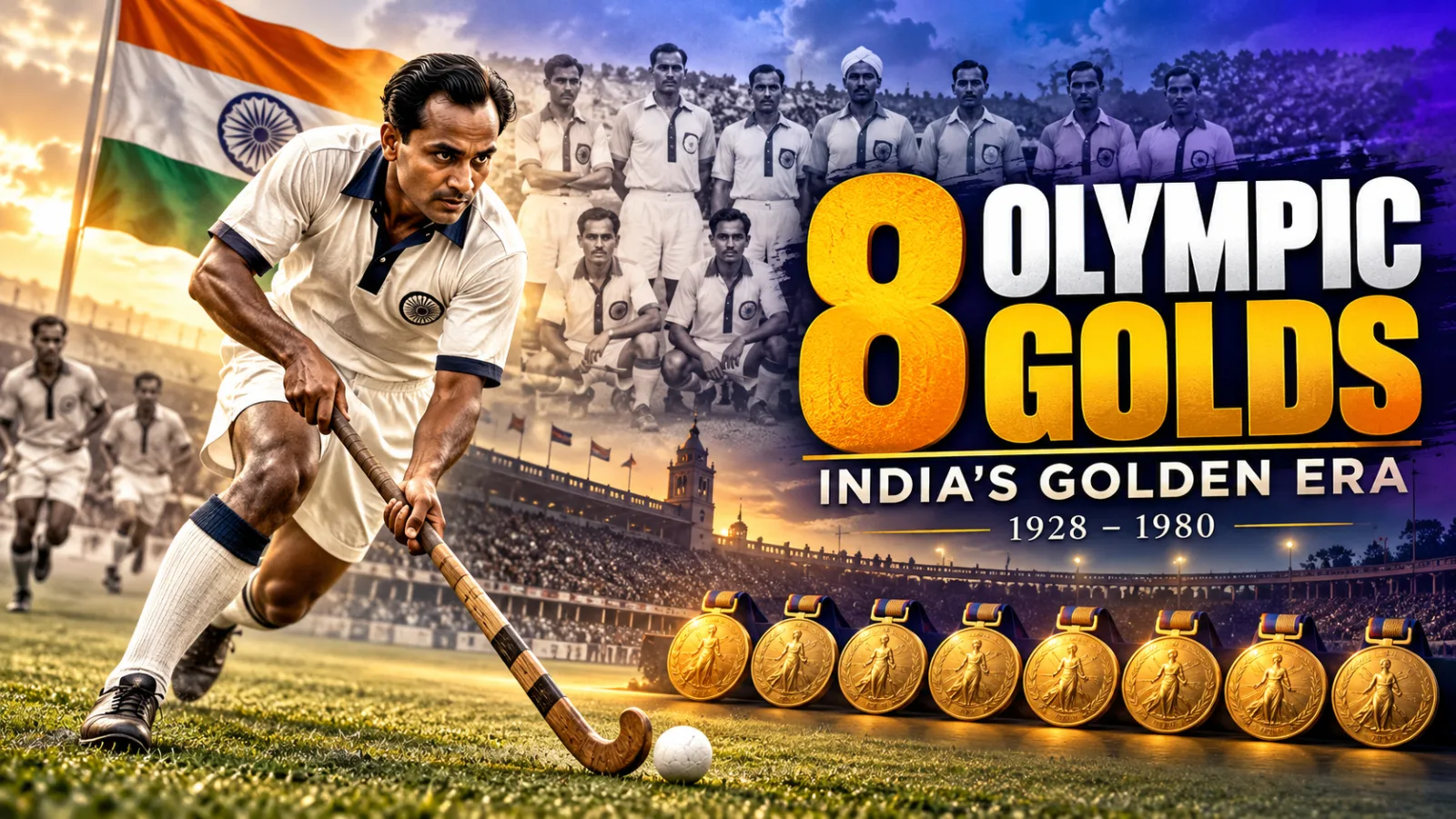
There was a time when hockey in the world simply meant India. From 1928 to 1956 India won six Olympic golds in a row, and eight hockey golds in all — a record for any country. This was the golden age of Indian hockey, which gave the country its first Olympic heroes.
Eight Olympic golds
| Year | City | Final / what stands out |
|---|---|---|
| 1928 | Amsterdam | India's first Olympic gold; beat the Netherlands 3–0 in the final |
| 1932 | Los Angeles | Beat the United States 24–1 — a record win |
| 1936 | Berlin | Captained by Dhyan Chand; beat Germany 8–1 in the final |
| 1948 | London | Independent India's first gold; beat Britain 4–0 in the final |
| 1952 | Helsinki | Beat the Netherlands 6–1 in the final |
| 1956 | Melbourne | Beat Pakistan 1–0 in the final |
| 1964 | Tokyo | Won gold back by beating Pakistan 1–0 in the final |
| 1980 | Moscow | The eighth and, so far, last gold |
At the 1960 Rome Olympics India won silver, and bronze in 1968, 1972, 2020 and 2024.
The wizard of hockey: Major Dhyan Chand
Major Dhyan Chand won gold at all three Olympics of 1928, 1932 and 1936. His control of the ball was so remarkable that he was called "the wizard of hockey". His birthday, 29 August, is celebrated in India as "National Sports Day", and in 2021 the country's highest sporting honour was renamed the "Major Dhyan Chand Khel Ratna Award".
1948: the first win after independence
Just a year after independence, on 12 August 1948 at Wembley Stadium in London, India beat in the final the very Britain that had ruled India for nearly two hundred years, by 4–0. It was the first Olympic gold under the flag of free India, and a film was later made on the story. Balbir Singh Senior of this team scored 5 goals in the 1952 final — the record for the most goals by a player in an Olympic men's hockey final is still his.
Did you know? Many people believe hockey is India's national game, but the government has not officially declared any sport the "national game". The Sports Ministry said exactly this in reply to a Right to Information (RTI) request in 2012.
The 1975 World Cup, and then the decline
In 1975, at Kuala Lumpur in Malaysia, India under Ajit Pal Singh beat Pakistan 2–1 to win the men's Hockey World Cup — still India's only World Cup title. From 1976 artificial "astroturf" replaced grass at the Olympics. Indian hockey relied on artistic dribbling, while on the new surface the fast, powerful European style worked better. India then had very few astroturf pitches, so its results kept falling.
The comeback at Tokyo and Paris
At Tokyo 2020 the Indian men's team beat Germany to win bronze, ending a 41-year wait for an Olympic medal. At Paris 2024 the team beat Spain to win bronze again — medals at two Olympics in a row for the first time since 1972. Goalkeeper P.R. Sreejesh retired from international hockey after Paris. Read about all of India's Olympic medals in India's Olympic medals.
Key points
- India has won 8 Olympic golds in hockey — more than any other country.
- Six golds came in a row from 1928 to 1956.
- Major Dhyan Chand's birthday, 29 August, is National Sports Day.
- India won its only men's Hockey World Cup in 1975.
- India won bronze at Tokyo 2020 and Paris 2024.
Frequently asked questions
How many Olympic golds has India won in hockey?
Eight — in 1928, 1932, 1936, 1948, 1952, 1956, 1964 and 1980.
Is hockey India's national game?
No, India has not officially declared any sport its national game.
Hockey's stars: Hockey personalities · More articles: Interesting facts.
Sources
Found this useful? Share it.