
How coins are made: from the mint to your pocket
Every coin in your pocket was struck in one of four government mints and sent to you through the RBI and the banks. Here is the whole journey, step by step.
Rohit Tandon · 30 October 2026 · 4 min read
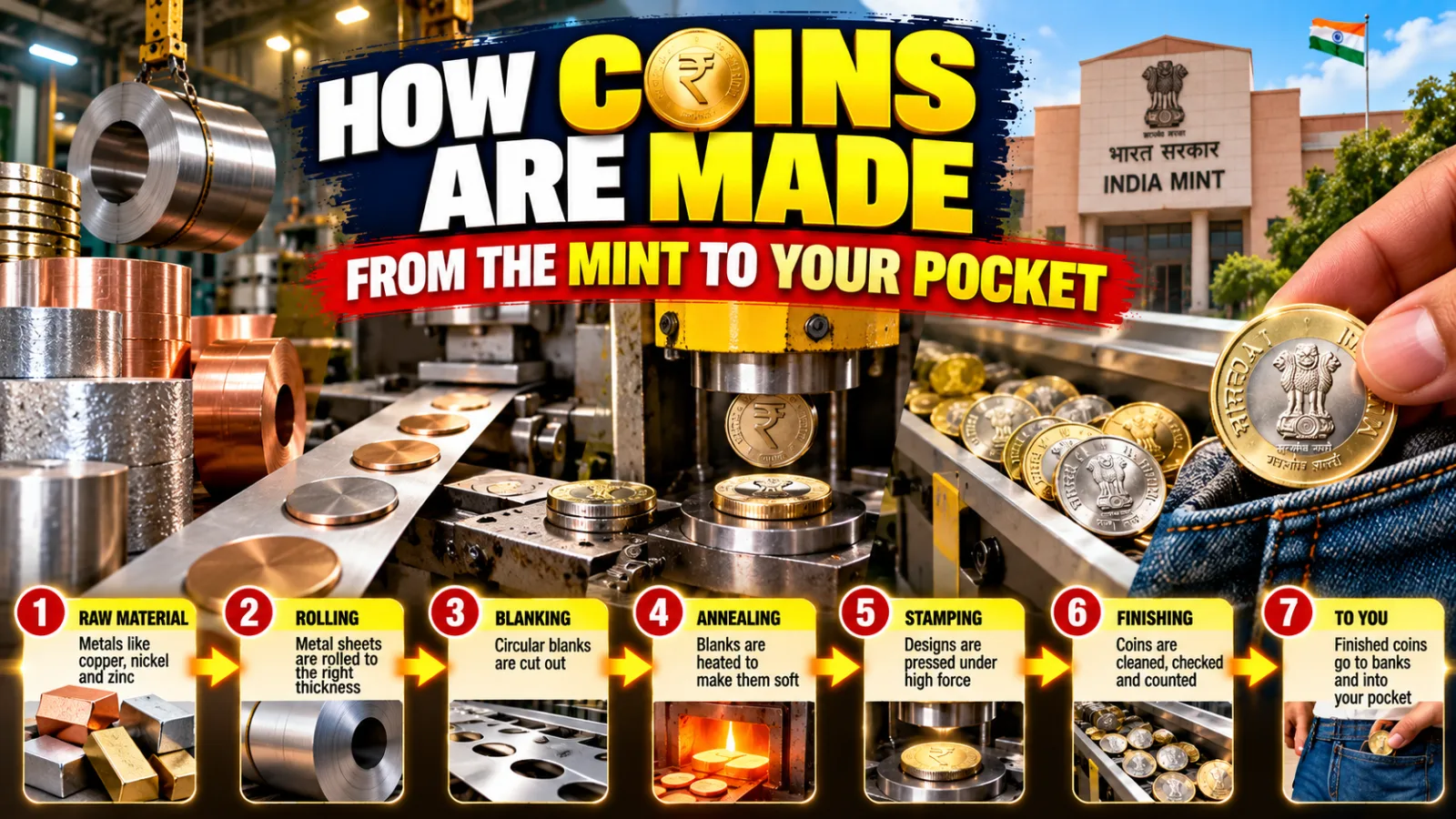
सिक्के कैसे बनते हैं — how are coins made? In India, a coin starts as a long coil of metal in a government mint. Machines cut it into plain discs, soften them in a furnace, press the design onto both faces in a single blow, then count and bag the coins for the Reserve Bank of India, which sends them to banks and on to your pocket.
The ₹1 you hand to the kirana shopkeeper has made that whole trip. The steps also explain the small mark under the year and why some coins stick to a magnet.
Who decides which coins India makes?
Only the Government of India has the right to make coins. The Coinage Act, 2011 lets the government decide the value, size, metal and design of each coin, and it caps the face value of any coin at ₹1,000. This is why the Finance Ministry, not the Reserve Bank, announces a new series of coins.
The striking is done by the Security Printing and Minting Corporation of India Ltd (SPMCIL), a company fully owned by the government. The RBI then takes the coins over and puts them into circulation.
Where are India's coins made, and how can you tell?
SPMCIL runs four India Government Mints, in Mumbai, Kolkata, Hyderabad and Noida. Each mint leaves its own small mark just below the year, so any coin at home tells you where it was born.
| Mint | Mark below the year | One fact worth knowing |
|---|---|---|
| Mumbai | A small diamond ◆ | Has been striking coins since 1829 |
| Hyderabad | A star ★ | One of the four mints under SPMCIL |
| Noida | A dot ● | The only mint set up after Independence; work began in January 1986 and it opened on 1 July 1988 |
| Kolkata | No mark | Its present building at Alipore opened on 19 March 1952 |
A coin with no mark is therefore from Kolkata. Children doing a project on the old names of India often notice that every coin carries both "भारत" and "INDIA".
How is a coin made, step by step?
The mint receives metal in long rolled coils of the right thickness. A blanking press punches plain round discs out of the strip, the way a cook cuts rounds out of rolled dough with a steel tumbler. These discs are called blanks, and the leftover strip goes back for melting.
Punching makes the metal hard and brittle, so the blanks are heated in a furnace and cooled slowly. This step, called annealing, softens the metal so it can take a sharp design. The blanks are then washed and dried, because dirt or oil would spoil the face of the coin.
Next, a rimming machine raises a thin rim on each blank, which protects the design when coins rub together in a gullak. Finally, in the coining press, two hardened steel dies strike the blank from above and below at the same instant. The coins are then checked, counted by machine and packed in sealed bags; the Noida mint, says SPMCIL, has no blanking press and strikes blanks sent by its sister mints.
Did you know? The ₹1 and ₹2 coins are made of ferritic stainless steel, which is about 83% iron and 17% chromium. Because of the iron, these coins cling to a fridge magnet, while the copper-rich ring of a ₹10 coin does not.
What metal is your coin made of?
A ₹1 coin may pass from a bus conductor's leather bag to a wet vegetable market in the monsoon, so it needs a metal that does not rust or wear out quickly. Stainless steel suits this job well.
Under the rules notified in March 2019, the ₹1 coin is 20 mm across and the ₹2 coin 23 mm, both in stainless steel. The ₹10 coin has an outer ring of nickel brass and a centre of nickel silver, so its two colours are easy to recognise.
How does a coin travel from the mint to your pocket?
From the mint, sealed bags go to the RBI, which sends them on through its offices and currency chests, storehouses kept by banks on its behalf. Your bank branch draws coins from there for shops, bus depots and customers.
Coins of ₹1 and above are legal tender for any amount up to ₹1,000, and the 50 paise coin for up to ₹10; a defaced or badly worn coin stops being legal tender. In wedding season, banks see a rush for fresh ₹1 coins for the shagun envelope, one of many traditions of Indian culture.
Key points
- Under the Coinage Act, 2011, only the Government of India makes coins, and no coin can be worth more than ₹1,000.
- SPMCIL strikes coins in four mints: Mumbai (◆), Hyderabad (★), Noida (●) and Kolkata (no mark).
- The steps are: metal strip, blanking, annealing, cleaning, rimming, striking, checking, counting and bagging.
- ₹1 and ₹2 coins are stainless steel and stick to a magnet; the ₹10 coin uses two metals.
- The RBI distributes coins through its offices, currency chests and banks.
Frequently asked questions
Who makes coins in India, the RBI or the government?
The Government of India makes coins through SPMCIL's four mints, and the RBI distributes them through banks. Banknotes are different, because the RBI issues those.
How can I tell which mint made my coin?
Look just below the year. A diamond means Mumbai, a star Hyderabad, a dot Noida, and no mark Kolkata.
Does a shopkeeper have to accept coins for a big bill?
Only up to ₹1,000 in one payment for coins of ₹1 and above. Beyond that, the law does not require anyone to accept coins; more reads like this are in our amazing facts section.
Sources: The Coinage Act, 2011 (India Code) and Security Printing and Minting Corporation of India Ltd.
Sources
Found this useful? Share it.