
Sardar Patel and the integration of the princely states
In 1947, more than 560 princely states covered about 40% of India's land. This is how Sardar Patel and V.P. Menon brought them into one country, and why three states took longer.
Rohit Tandon · 27 October 2026 · 3 min read
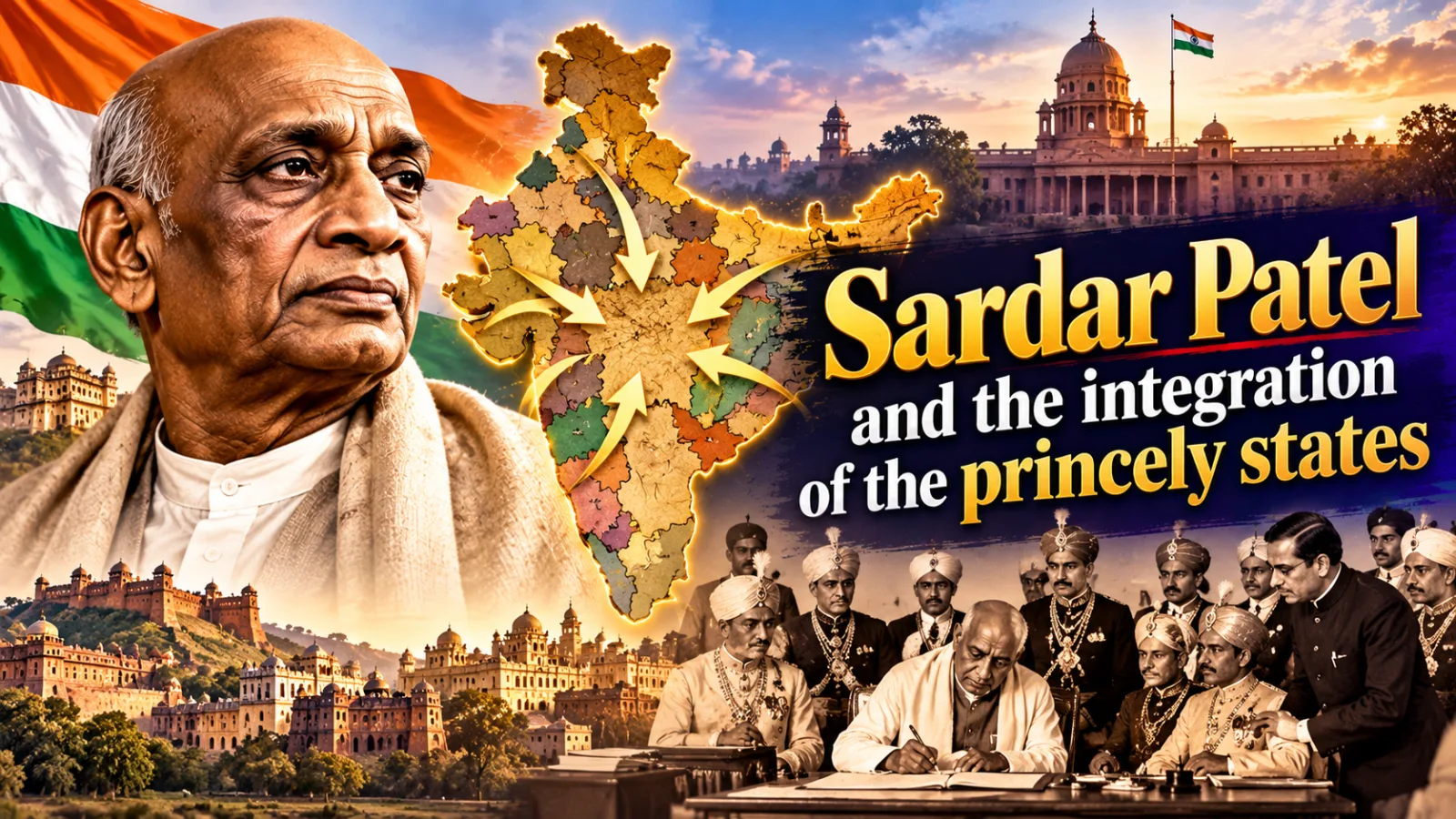
सरदार पटेल और रियासतों का विलय means Sardar Patel and the integration of the princely states, the work that turned a patchwork map into one India. When freedom came on 15 August 1947, more than 560 princely states were free to choose India, Pakistan or independence. Within about two years, almost all of them had joined India, largely through the patient, firm effort of Sardar Vallabhbhai Patel and his secretary V.P. Menon.
How big was the challenge in 1947?
Under the British, India had two kinds of territory. The provinces were ruled directly, while the princely states were ruled by rajas, maharajas and nawabs who accepted British supremacy. Together these states covered about 40% of India's land, and they ranged from huge Hyderabad to estates no bigger than a handful of villages. Our page on British India and the Raj from 1858 to 1947 explains how this system grew.
When the British left, their supremacy over the states ended too. Imagine a train going from Delhi to Madras in 1947: on its way it would have crossed land ruled by different princes. If each state had gone its own way, India would have been a map full of holes, with separate customs posts, armies and rules at every border.
What was Patel's plan?
On 5 July 1947, a States Department was set up with Home Minister Sardar Patel in charge and V.P. Menon as its secretary. Their main tool was the Instrument of Accession. A ruler who signed it handed only three subjects to the Indian government: defence, external affairs and communications, and kept the rest for the time being.
Patel used both warmth and firmness. He appealed to the rulers' patriotism, invited them to lunches and meetings, and reminded them that their people wanted to be part of free India. Most rulers signed before 15 August 1947. Later, small states were merged into bigger units, and the rulers were given an annual allowance called the privy purse, which was ended in 1971.
Which states took longer to join?
Three states did not join India by 15 August 1947: Junagadh, Jammu and Kashmir, and Hyderabad. Each had a different problem, and each was settled in a different way. The table below gives the key dates.
| State | The problem | How it was settled | Year |
|---|---|---|---|
| Junagadh | The Nawab announced accession to Pakistan, though most people wanted India | Indian administration took over; a plebiscite in February 1948 voted overwhelmingly for India | 1948 |
| Jammu and Kashmir | Maharaja Hari Singh delayed his decision; raiders from Pakistan attacked | The Maharaja signed the Instrument of Accession on 26 October 1947 | 1947 |
| Hyderabad | The Nizam wanted to stay independent; violence by the Razakars grew | Operation Polo, 13–17 September 1948; the Nizam surrendered on 17 September | 1948 |
| Small states of Kathiawar | Over 200 tiny states in one region | Joined into the Union of Saurashtra | 1948 |
| Rajputana states | Many princely states of different sizes | Merged in stages into the state of Rajasthan | 1949 |
Hyderabad was the hardest case because it was large, rich and right in the middle of India. Operation Polo lasted only a few days, and 17 September is still remembered in the region. The freedom movement had promised one India, a dream you can feel in the famous slogans of India's freedom struggle.
Why is Patel called the Iron Man of India?
Patel earned the title "Sardar", meaning leader, during the Bardoli Satyagraha of 1928, when he led farmers against a steep rise in land tax. The name "Iron Man" came from the steady will he showed in 1947 and 1948. He worked closely with Prime Minister Jawaharlal Nehru, about whom you can read in 10 key facts about Jawaharlal Nehru.
Patel was born on 31 October 1875 in Nadiad, Gujarat, and died on 15 December 1950. He did not live to see the full results of his work, but the map he helped draw is the base of today's states. He was given the Bharat Ratna after his death, in 1991.
Did you know? The Statue of Unity in Gujarat, built in Patel's honour near the Narmada river, is 182 m tall, about twice the height of the Statue of Liberty in New York, and is the tallest statue in the world.
How do we remember the integration today?
Since 2014, Patel's birthday, 31 October, has been observed as Rashtriya Ekta Diwas, or National Unity Day. Schools and offices hold a "Run for Unity" and take a pledge to keep the country united. Many students learn the story first in a school assembly on that morning.
The Statue of Unity near Kevadia was opened on 31 October 2018 and has become a favourite family trip in Gujarat. When tourists stand at its viewing gallery and look at the Sardar Sarovar Dam, they see a reminder of how one person's patient work joined hundreds of pieces. To read more stories from this period, see our page on India's freedom struggle from 1857 to 1947.
Key points
- More than 560 princely states covered about 40% of India's land in 1947.
- The States Department was set up on 5 July 1947 under Sardar Patel, with V.P. Menon as secretary.
- The Instrument of Accession handed over only defence, external affairs and communications.
- Junagadh, Jammu and Kashmir, and Hyderabad joined after 15 August 1947.
- Patel's birthday, 31 October, is observed as Rashtriya Ekta Diwas.
Frequently asked questions
How many princely states were there in 1947?
There were more than 560 princely states, big and small. Together they covered about 40% of the land of undivided India.
What was the Instrument of Accession?
It was a legal document a ruler signed to join India. By signing it, the state handed over defence, external affairs and communications to the Indian government.
When did Hyderabad join India?
Hyderabad joined after Operation Polo, which ran from 13 to 17 September 1948. The Nizam surrendered on 17 September 1948. More such stories are in our history articles.
Sources: Encyclopaedia Britannica: Vallabhbhai Patel and Statue of Unity, official website.
Sources
Found this useful? Share it.