
States and capitals of India: the full list of 28 states
India has 28 states and 8 union territories. Here is every state with its capital, the states with two capitals, and simple ways to remember them.
Rohit Tandon · 29 October 2026 · 3 min read
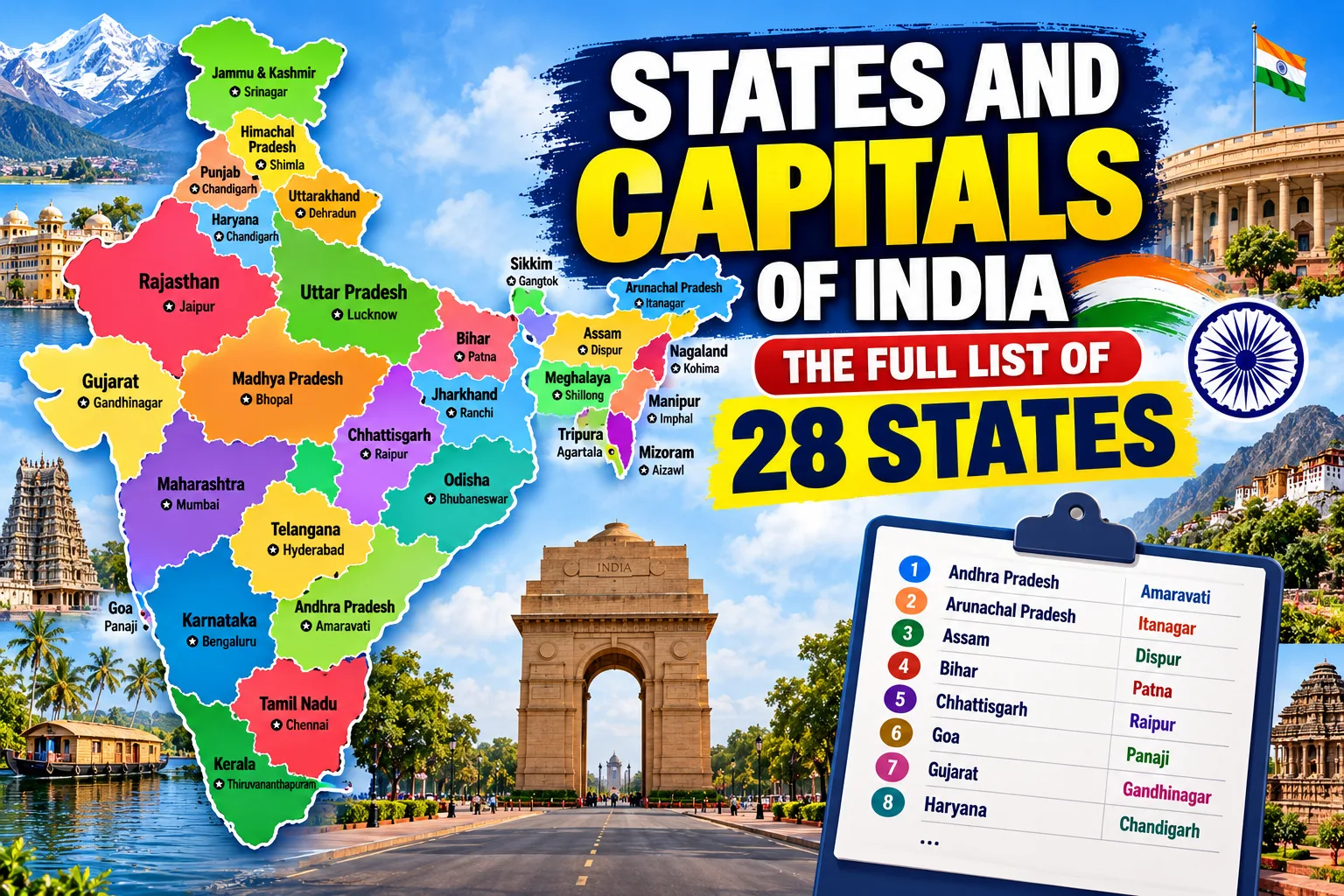
India has 28 states and 8 union territories, and each state has its own capital, where its government and legislative assembly sit. This page lists the states and capitals of India (भारत के राज्य और राजधानियाँ) in one table. It also explains why some states have two capitals and how the list came to look the way it does.
What are the 28 states and their capitals?
The table below follows the alphabetical order of the states. Read it once from top to bottom, and then read only the capitals column. Most learners find that the second reading fixes the pairs in memory far better than the first.
| State | Capital | State | Capital |
|---|---|---|---|
| Andhra Pradesh | Amaravati | Manipur | Imphal |
| Arunachal Pradesh | Itanagar | Meghalaya | Shillong |
| Assam | Dispur | Mizoram | Aizawl |
| Bihar | Patna | Nagaland | Kohima |
| Chhattisgarh | Raipur | Odisha | Bhubaneswar |
| Goa | Panaji | Punjab | Chandigarh |
| Gujarat | Gandhinagar | Rajasthan | Jaipur |
| Haryana | Chandigarh | Sikkim | Gangtok |
| Himachal Pradesh | Shimla (winter: Dharamshala) | Tamil Nadu | Chennai |
| Jharkhand | Ranchi | Telangana | Hyderabad |
| Karnataka | Bengaluru | Tripura | Agartala |
| Kerala | Thiruvananthapuram | Uttar Pradesh | Lucknow |
| Madhya Pradesh | Bhopal | Uttarakhand | Dehradun (summer: Bhararisain, Gairsain) |
| Maharashtra | Mumbai (second capital: Nagpur) | West Bengal | Kolkata |
Notice that Chandigarh appears twice. It is the capital of both Punjab and Haryana, yet it belongs to neither state, because Chandigarh is itself a union territory run by the Centre.
Why does India have states at all?
The very first article of the Constitution says, "India, that is Bharat, shall be a Union of States." A country as large as India cannot be run well from one office in Delhi alone. Dividing it into states lets each region manage its own police, farming, schools and hospitals in its own language.
Think of a large joint family that runs one big kitchen. The family shares one roof and one name, but each branch handles its own daily cooking. The Union government looks after defence, currency and foreign affairs, while the states look after matters that touch daily life most closely. You can read more about how this system works in our articles on Indian Polity.
How does a state government work?
Every state has a Governor, who is appointed by the President of India. The real work, however, is done by the Chief Minister and the council of ministers, who are chosen from the party or group with a majority in the state assembly, the Vidhan Sabha. Voters elect the members of this assembly, normally once every five years.
Six states also have an upper house called the Vidhan Parishad: Andhra Pradesh, Bihar, Karnataka, Maharashtra, Telangana and Uttar Pradesh. The capital is simply the city where the assembly, the secretariat and the Governor's residence (Raj Bhavan) are located. That is why the capital is often not the largest city of a state, as you can see with Dispur, which sits inside the bigger city of Guwahati.
How did today's map of states take shape?
At independence, India was a patchwork of British provinces and more than 500 princely states. Our article on British India from 1858 to 1947 explains how that patchwork came to be. After 1947 these units were first merged into larger groups, and then redrawn.
The States Reorganisation Act of 1956 redrew the map mainly on the basis of language, creating 14 states and 6 union territories. Since then, new states have been carved out many times. Chhattisgarh, Uttarakhand and Jharkhand were formed in 2000, and Telangana, the youngest state, was formed on 2 June 2014. In 2019 the state of Jammu and Kashmir was reorganised into two union territories, which is why the count fell from 29 to 28.
Did you know? After Telangana was formed in 2014, Hyderabad served as the shared capital of both Telangana and Andhra Pradesh for 10 years, until 2 June 2024.
Which states have special capital arrangements?
A few states do not fit the simple "one state, one capital" pattern. Himachal Pradesh uses Shimla as its capital and Dharamshala as its winter capital. Uttarakhand has Dehradun as its capital and Bhararisain in Gairsain as its summer capital. Maharashtra has Mumbai as its capital, and its assembly holds a session every winter in Nagpur, its second capital.
These arrangements are about weather and fairness to different regions. A hill state finds it hard to run every office from a town that is snowbound in January. Holding sessions in a second city also brings government closer to people in a far region, much like a school that holds one annual function in a village branch so that families there need not travel.
How can you remember states and capitals easily?
Link each pair with something you already know. Many vehicle number plates start with a state code, such as MH for Maharashtra or KA for Karnataka, so the next time you see a car on the road, recall that state's capital. Cricket fans can do the same with Ranji Trophy teams, most of which are named after states.
Region-wise grouping also helps. Learn the seven north-eastern states together: Arunachal Pradesh, Assam, Manipur, Meghalaya, Mizoram, Nagaland and Tripura, and add Sikkim as the eighth. On a long train journey, try naming the capital of every state the train passes through. Our article on the old names of India is a good next read if you enjoy this kind of map-based learning.
Key points
- India has 28 states and 8 union territories.
- Article 1 of the Constitution calls India a "Union of States".
- Chandigarh is the capital of both Punjab and Haryana, but is itself a union territory.
- Telangana, formed on 2 June 2014, is the youngest state.
- Himachal Pradesh, Uttarakhand and Maharashtra have a second or seasonal capital.
- Six states have a legislative council (Vidhan Parishad) as well as an assembly.
Frequently asked questions
How many states are there in India?
There are 28 states and 8 union territories in India. The number of states fell from 29 to 28 in 2019, when Jammu and Kashmir became a union territory.
Which city is the capital of two states?
Chandigarh is the capital of both Punjab and Haryana. The city is a union territory, so it is governed by the Centre and not by either state.
Is Guwahati the capital of Assam?
No, the capital of Assam is Dispur. Dispur lies within the larger city of Guwahati, which is why the two names are often confused.
Sources: States and union territories of India (encyclopaedia) and The Constitution of India, Legislative Department. The second is an official page of the Government of India.
Sources
Found this useful? Share it.