
Old names of Indian states and cities, and when they changed
Madras became Tamil Nadu, Orissa became Odisha and Calcutta became Kolkata. Here are the old names of Indian states and cities, with dates and reasons.
Rohit Tandon · 29 October 2026 · 4 min read
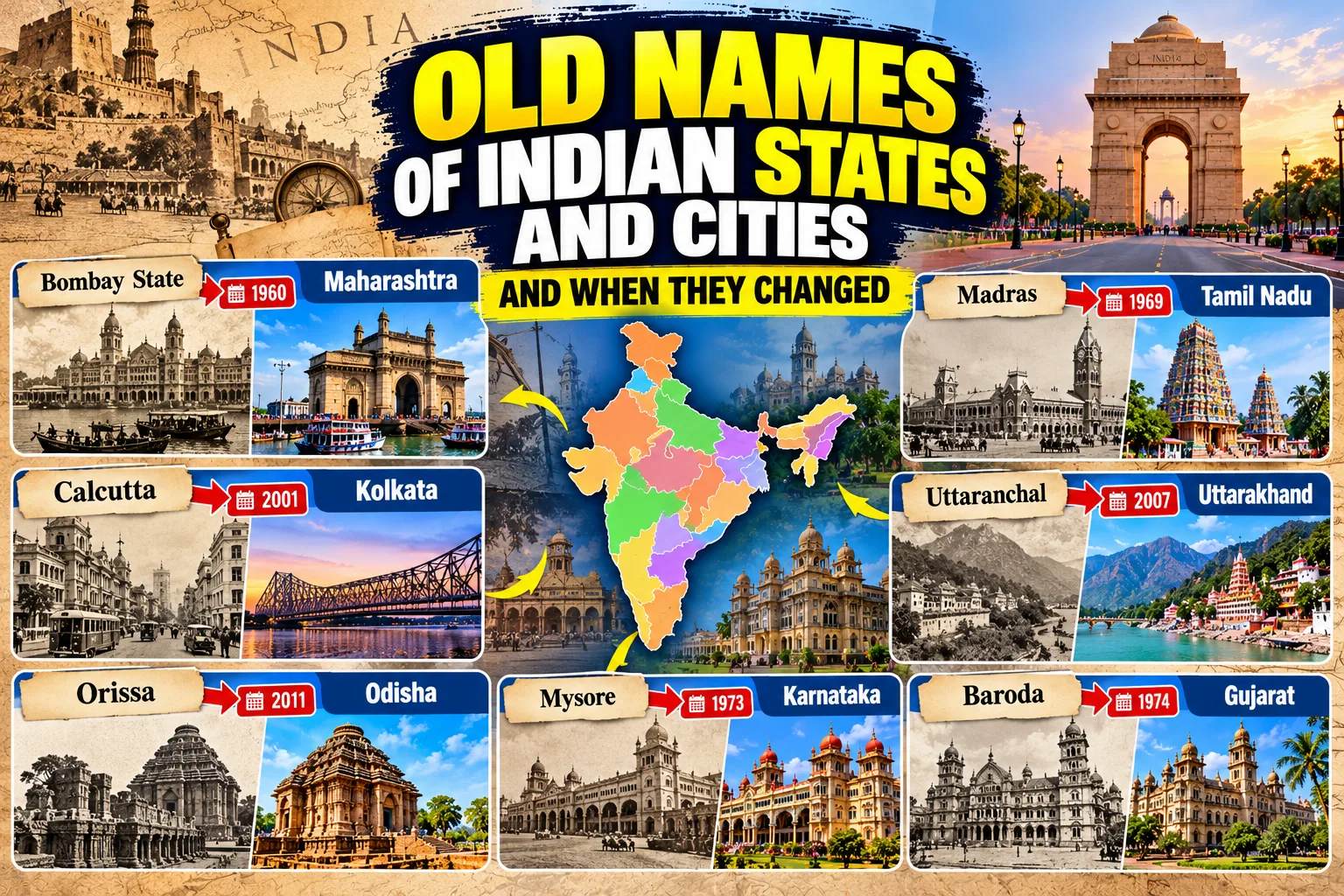
Many Indian states and cities have changed their names since 1947, such as Madras State to Tamil Nadu, Orissa to Odisha and Calcutta to Kolkata. This page lists the old names of Indian states and cities (राज्यों और शहरों के पुराने नाम) with the year of each change. It also explains why the names changed and who has the power to change them.
Which states had different names earlier?
The table below lists the main states and union territories that carry a new name today. Some changes came when a state was formed, and others came decades later, once people asked for a name closer to their own language.
| Old name | New name | When |
|---|---|---|
| United Provinces | Uttar Pradesh | 1950 |
| Travancore-Cochin (and Malabar) | Kerala | 1956 |
| Madras State | Tamil Nadu | 1969 |
| North-East Frontier Agency (NEFA) | Arunachal Pradesh | 1972 (state in 1987) |
| Mysore State | Karnataka | 1973 |
| Laccadive, Minicoy and Amindivi Islands | Lakshadweep | 1973 |
| Pondicherry | Puducherry | 2006 |
| Uttaranchal | Uttarakhand | 2007 |
| Orissa | Odisha | 2011 |
The United Provinces became Uttar Pradesh on 24 January 1950, which is why the state now marks 24 January as its foundation day. Notice how most new names come from the local language itself: Odisha is simply how Odia speakers say the name, and Uttarakhand is the old name used for the hills in local tradition.
How did Bombay State turn into two states?
After independence, Bombay State covered the land of today's Maharashtra and Gujarat. Marathi and Gujarati speakers each wanted a state of their own, and the Samyukta Maharashtra and Mahagujarat movements grew strong in the 1950s. On 1 May 1960 Bombay State was divided into Maharashtra and Gujarat.
Both states celebrate 1 May as their foundation day, Maharashtra Din and Gujarat Sthapana Divas. This split is a good example of how language shaped the map of India. A similar idea runs through the wider story of India's languages and culture, where every region holds on to its own speech and festivals.
Which big cities changed their names?
City names began changing in large numbers in the 1990s. Bombay became Mumbai in 1995, after Mumba Devi, the goddess of the island's Koli fishing families. Madras became Chennai in 1996, and Calcutta became Kolkata in 2001. Bangalore became Bengaluru and Mysore became Mysuru in 2014.
Smaller and newer changes are also asked in exams. Trivandrum is now Thiruvananthapuram, Cochin is Kochi, Gurgaon became Gurugram in 2016 and Allahabad became Prayagraj in 2018. In 2024 Port Blair, the capital of the Andaman and Nicobar Islands, was renamed Sri Vijaya Puram. Your grandparents may still say "Bombay" or "Madras" out of habit, and old film songs keep the earlier names alive.
Did you know? The famous railway station in Mumbai has had three names: Victoria Terminus, then Chhatrapati Shivaji Terminus in 1996, and Chhatrapati Shivaji Maharaj Terminus in 2017.
Why are names changed at all?
The most common reason is pronunciation. Many old spellings were written by British officials who heard local names through English ears, so "Kolkata" and "Chennai" are closer to how people there have always spoken. Our article on British India from 1858 to 1947 shows how much of the colonial map was drawn and named in English.
The second reason is history and identity. A name can recall a goddess, a river, a ruler or an ancient town, and people feel proud when their home carries it. The country's own name has the same layered story, which you can read in our article on the old names of India.
Who decides when a name changes?
Changing the name of a state needs a law passed by Parliament under Article 3 of the Constitution. The bill is first sent to the state's assembly for its views, though Parliament is not bound by them. Orissa became Odisha in this way, through an Act of Parliament in 2011.
A city, town or railway station is renamed by the state government, which usually seeks a no-objection certificate from the Union Ministry of Home Affairs. Before agreeing, the ministry checks with bodies such as the Railways, the Department of Posts and the Survey of India. After a change, everything from the station boards on your train journey to the address on a wedding card slowly catches up, though the PIN code stays the same. For more such stories from the past, browse our History articles.
Key points
- The United Provinces became Uttar Pradesh on 24 January 1950.
- Madras State became Tamil Nadu in 1969 and Mysore State became Karnataka in 1973.
- Bombay State was split into Maharashtra and Gujarat on 1 May 1960.
- Orissa became Odisha and Uttaranchal became Uttarakhand through Acts of Parliament.
- Bombay, Madras and Calcutta became Mumbai, Chennai and Kolkata between 1995 and 2001.
- A state's name can change only by a law of Parliament under Article 3.
Frequently asked questions
What was the old name of Tamil Nadu?
Tamil Nadu was called Madras State until 1969. The new name means "the land of the Tamils".
When did Orissa become Odisha?
Orissa became Odisha in 2011, and its language Oriya became Odia at the same time. The change was made by an Act of Parliament.
What was Kolkata called earlier?
Kolkata was officially called Calcutta until 2001. The new spelling follows the way Bengali speakers have always said the name.
Sources: The Constitution of India, Legislative Department and List of renamed Indian cities and states (encyclopaedia). The first gives the text of Article 3.
Sources
Found this useful? Share it.