
Union territories of India: the 8 UTs, their capitals and how they are run
India has 8 union territories, run by the Centre through a Lieutenant Governor or an Administrator. Here are their capitals, their assemblies and the reasons they exist.
Rohit Tandon · 29 October 2026 · 3 min read
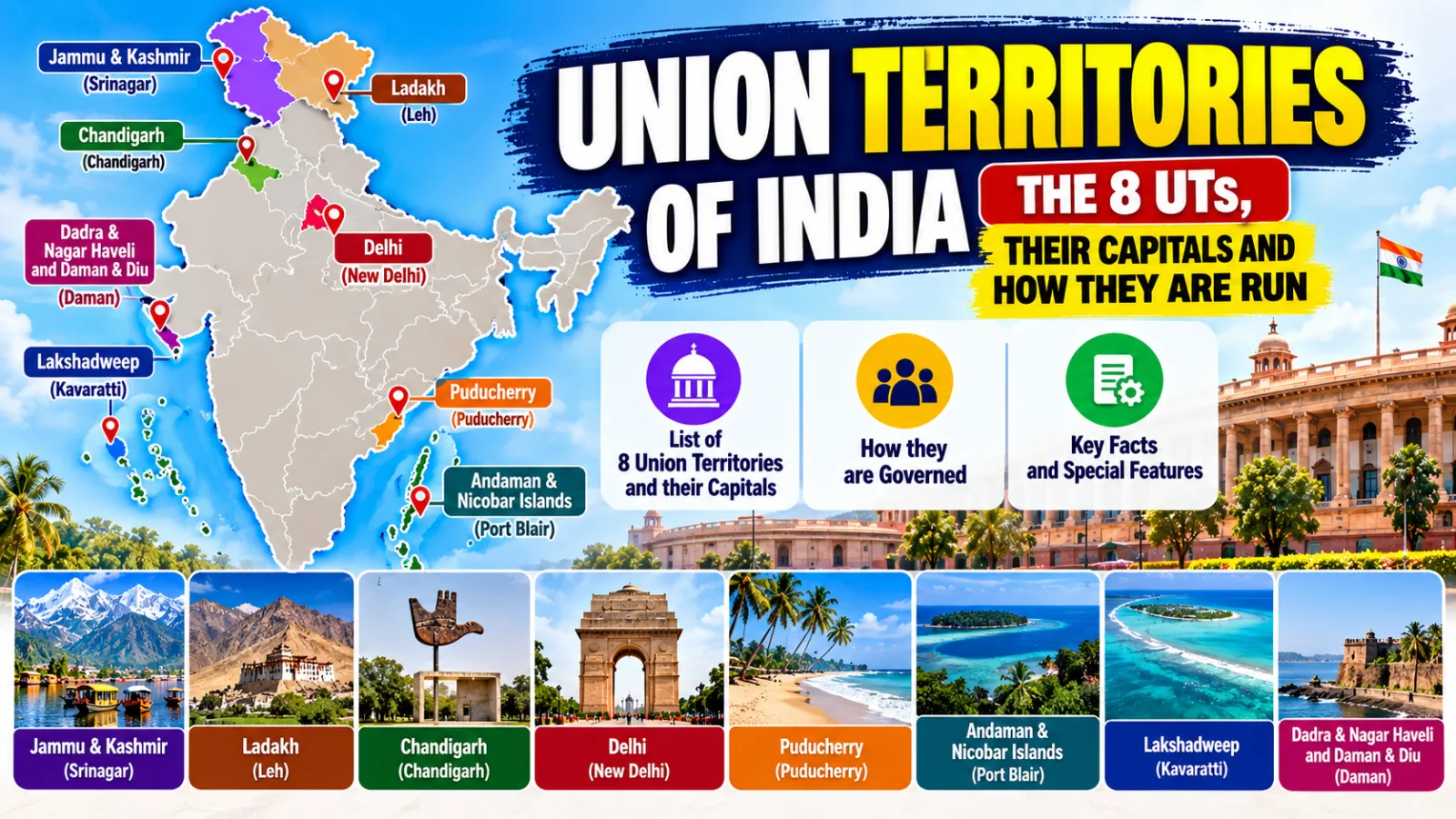
India has 8 union territories, areas that are governed directly by the Union government instead of by a state government of their own. These union territories of India (भारत के केंद्र शासित प्रदेश) range from tiny coral islands to the national capital. Three of them have their own elected assembly, while the other five are run fully by an official chosen by the Centre.
Which are the 8 union territories and their capitals?
The table below shows every union territory, its capital, whether it has a legislative assembly and who heads its administration. Read the "Assembly" column carefully, because exam questions often ask which UTs elect their own government.
| Union territory | Capital | Assembly | Head of administration |
|---|---|---|---|
| Andaman and Nicobar Islands | Sri Vijaya Puram (formerly Port Blair) | No | Lieutenant Governor |
| Chandigarh | Chandigarh | No | Administrator (the Governor of Punjab) |
| Dadra and Nagar Haveli and Daman and Diu | Daman | No | Administrator |
| Delhi (National Capital Territory) | New Delhi | Yes | Lieutenant Governor |
| Jammu and Kashmir | Srinagar (summer), Jammu (winter) | Yes | Lieutenant Governor |
| Ladakh | Leh | No | Lieutenant Governor |
| Lakshadweep | Kavaratti | No | Administrator |
| Puducherry | Puducherry | Yes | Lieutenant Governor |
So Delhi, Jammu and Kashmir and Puducherry elect assemblies and have a Chief Minister. The remaining five have no assembly, and laws for them are made by Parliament or through regulations issued by the President.
Why does India have union territories?
There is no single reason; each union territory has its own story. Island groups such as the Andaman and Nicobar Islands and Lakshadweep lie far out at sea and matter greatly for the country's defence. Ladakh is a high, cold border region where the Centre wants direct control of planning and security.
Other areas are simply too small to work as states, like Daman and Diu. Puducherry was a French colony, so it kept a separate identity after joining India. Delhi is the seat of the Union government, so the Centre keeps a hand in its police and land. You can read how such special cases fit into the wider system in our articles on Indian Polity.
How is a union territory run?
Article 239 of the Constitution says that every union territory is administered by the President, acting through an Administrator whom the President appoints. In some UTs this official is called the Lieutenant Governor. Chandigarh is unusual, because the Governor of Punjab also serves as its Administrator.
A simple school example helps here. In a class with an elected monitor, students choose who speaks for them, but the class teacher still has the final word on many things. A UT with an assembly works a little like that, while a UT without one is like a class run only by the teacher. Delhi's special status comes from Article 239AA, added by the 69th Amendment in 1991, which gave it an elected assembly and a council of ministers.
Did you know? Lakshadweep is India's smallest union territory, with a land area of only about 32 square kilometres spread over a group of coral islands in the Arabian Sea.
How did the list change in recent years?
The list of union territories has changed more than once since independence. Several former UTs, such as Goa, Mizoram and Arunachal Pradesh, later became full states. The map you see today took its present form only after 2019.
On 31 October 2019 the state of Jammu and Kashmir was reorganised into two union territories, Jammu and Kashmir and Ladakh. Then, on 26 January 2020, Dadra and Nagar Haveli was merged with Daman and Diu to make a single UT. In 2024 the capital of the Andaman and Nicobar Islands, Port Blair, was renamed Sri Vijaya Puram. Our article on British India from 1858 to 1947 explains how many of these regions were run before 1947.
What makes each union territory special to visit?
Each UT feels very different from the others, which makes them a favourite topic for school projects. Chandigarh was planned by the architect Le Corbusier, and families on a weekend drive often notice its numbered sectors and wide green belts. Puducherry still has French street names and a quiet seaside promenade.
A trip to Lakshadweep needs an entry permit, and most visitors reach it by ship or a small flight from Kochi. Ladakh's high passes are closed for long parts of winter, so supplies are stocked up before the snow, much as a village family fills its grain store before the monsoon. For more surprising records from across the country, read our facts about India for kids.
Key points
- India has 8 union territories, run directly by the Union government.
- Delhi, Jammu and Kashmir and Puducherry have their own elected assemblies.
- Under Article 239, the President runs each UT through an Administrator or Lieutenant Governor.
- Jammu and Kashmir and Ladakh became UTs on 31 October 2019.
- Dadra and Nagar Haveli and Daman and Diu became one UT on 26 January 2020.
- Lakshadweep is the smallest UT by area.
Frequently asked questions
How many union territories are there in India?
There are 8 union territories in India. The number became 8 in January 2020, after two smaller UTs were merged into one.
Which union territories have a legislative assembly?
Delhi, Jammu and Kashmir and Puducherry have elected assemblies. The other five union territories are governed without one.
Who is the head of a union territory?
The President of India is the constitutional head, acting through an Administrator. In Delhi, Puducherry, Jammu and Kashmir, Ladakh and the Andaman and Nicobar Islands, this official is called the Lieutenant Governor.
Sources: States and union territories of India (encyclopaedia) and Union Territories Division, Ministry of Home Affairs. The second is an official government page.
Sources
Found this useful? Share it.