
The seasons of India: six ritus and the weather office's four seasons
India's calendar has six ritus, from Vasant to Shishir, while the weather office counts four seasons. Here are both, with their months, crops and festivals, and the reason seasons change at all.
Rohit Tandon · 28 October 2026 · 4 min read
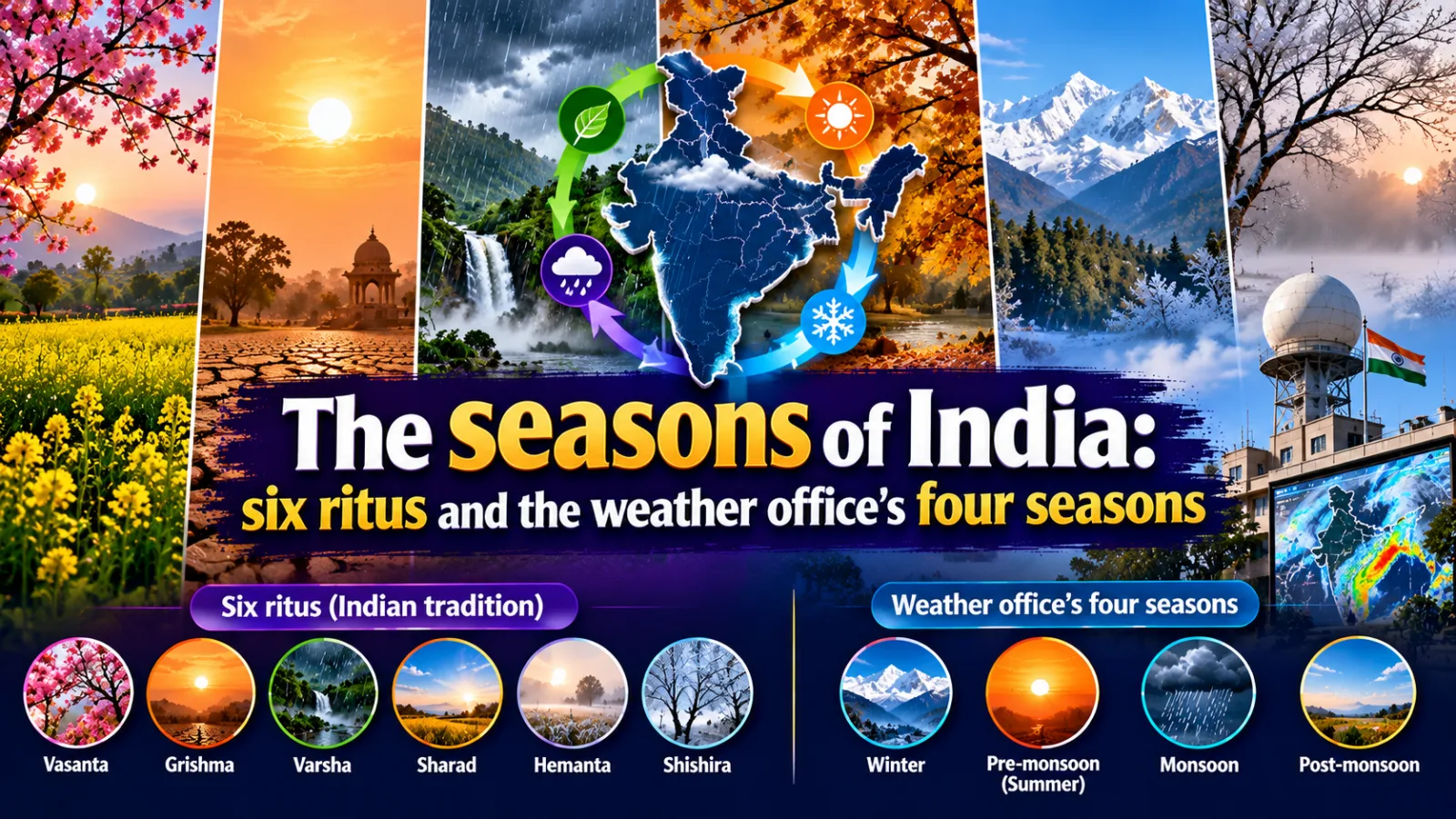
भारत की ऋतुएँ, the seasons of India, can be counted in two ways. The traditional Indian calendar has six ritus of about two months each: Vasant, Grishma, Varsha, Sharad, Hemant and Shishir. The India Meteorological Department (IMD) uses four seasons instead: winter, summer, the south-west monsoon and the post-monsoon season.
What are the six ritus of India?
The six ritus follow the Hindu lunar months, two months to a ritu. Because the lunar calendar shifts a little against the English calendar each year, the matching English months are only approximate. The table gives the usual pairing and what each season feels like.
| Ritu | Hindu months | About which English months | What you notice |
|---|---|---|---|
| Vasant (spring) | Chaitra–Vaishakh | March–April | Flowers, new leaves, mild weather |
| Grishma (summer) | Jyeshtha–Ashadh | May–June | Intense heat and the dry loo wind |
| Varsha (rains) | Shravan–Bhadrapad | July–August | Monsoon rain, full rivers |
| Sharad (autumn) | Ashvin–Kartik | September–October | Clear skies, a light chill at night |
| Hemant (pre-winter) | Margashirsha–Paush | November–December | Winter sets in |
| Shishir (winter) | Magh–Phalgun | January–February | Bitter cold and fog in the north |
These names are still part of daily speech. "Sawan" songs are sung in Shravan, the heart of Varsha, and many families still say "Jyeshtha ki garmi" for the worst heat of the year. The old names of the seasons, like the old names of India such as Bharatavarsha and Jambudvipa, carry a long memory of the land.
Which four seasons does the weather office use?
For forecasts and records, the IMD divides the year into four seasons. Winter runs from January to February, and the hot pre-monsoon season from March to May. The south-west monsoon season lasts from June to September, and the post-monsoon season, also called the north-east monsoon season, from October to December.
The four-season system fits the way India's weather actually works today. It puts all of the main rainy months into one season, which helps the IMD compare one year's rain with another. It also gives the north-east monsoon its own place, since Tamil Nadu gets much of its yearly rain from October to December, not in July.
Why do seasons change at all?
The Earth's axis is tilted by about 23.5 degrees. As the Earth goes round the Sun over a year, the northern half leans towards the Sun for some months and away from it for others. When it leans towards the Sun, the Sun stands higher at noon, days are longer and the land heats up, which gives India its summer.
You can test this in your own home. In June, the afternoon sun hardly enters a south-facing balcony because it is nearly overhead, while in December it reaches deep into the room because it stays low in the sky. Height also matters: hill stations stay cool in May, and snow on the major mountain peaks of India, from Kanchenjunga to Anamudi, lasts long after the plains are hot.
Which crops and festivals belong to each season?
Indian farming follows the seasons closely. Kharif crops such as paddy, maize and cotton are sown with the first monsoon rain and harvested around September and October. Rabi crops such as wheat, mustard and gram are sown in October and November and harvested in March and April, while a short zaid season in summer brings watermelon and cucumber.
Festivals often mark these turning points. Makar Sankranti and Pongal in mid-January celebrate the end of the coldest days, Holi arrives in Phalgun at the edge of spring, and Baisakhi in April marks the wheat harvest in Punjab. In Sharad, Diwali lights up the clear autumn nights after the rains. Monsoon water also feeds the great rivers described in the longest rivers of India: the Ganga, the Brahmaputra and the Indus.
Did you know? Kalidasa's poem "Ritusamhara" describes all six seasons, but it does not begin with spring. It opens with Grishma, the summer, and ends with Vasant.
Do all parts of India feel the same seasons?
No. India is so large that one month can feel very different in two places. In January, Delhi shivers in fog while Chennai is pleasant and Thiruvananthapuram is warm enough for cotton clothes. In May, the plains of Rajasthan bake in heat, but Shimla and Ooty stay cool.
The coasts have milder seasons because the sea keeps the air from getting too hot or too cold. Ladakh, high in the Himalayas, has long, very cold winters and only a short summer. Rain also varies greatly, and the monsoon feeds the major waterfalls of India mainly from July to September.
Key points
- The traditional calendar has six ritus: Vasant, Grishma, Varsha, Sharad, Hemant and Shishir.
- Each ritu covers two Hindu months, so the English months are approximate.
- The IMD uses four seasons: winter, pre-monsoon, south-west monsoon and post-monsoon.
- Seasons change because the Earth's axis is tilted by about 23.5 degrees.
- Kharif crops grow in the monsoon and rabi crops in winter.
Frequently asked questions
How many seasons does India have?
By the traditional calendar, India has six seasons, or ritus. The India Meteorological Department uses four seasons for its forecasts and records.
Which ritu comes in October?
October falls mostly in Sharad ritu, which covers the Hindu months of Ashvin and Kartik. The exact match changes slightly each year because of the lunar calendar.
What is the loo?
The loo is a hot, dry and dusty wind that blows over north and north-west India in the afternoons of May and June. It belongs to Grishma ritu. Read more in our geography articles.
Sources: India Meteorological Department and Encyclopaedia Britannica: Climate of India.
Sources
Found this useful? Share it.